Ideal Weight Calculator: How Much Should You Actually Weigh in India?
Most weight charts are built on Western body data. Here's how to find a target weight that actually fits an Indian frame — and the free calculator to do it in 30 seconds.
Type "ideal weight for my height" into Google and you'll get five different numbers from five different charts. None of them were built with an Indian frame in mind, and most people end up chasing a number that was never right for them in the first place. This guide fixes that — with the actual method and a free calculator that does the math for you.
Why most people fail at picking a target weight
The default move is picking a number off a BMI chart, aiming for it, and getting frustrated when the scale doesn't cooperate. The problem isn't effort — it's that the target itself was wrong from day one. A single number without a range, a timeline, or a body-composition check is a guess dressed up as a plan.
This matters more in India specifically, because most popular charts were built on European and American body composition data. Indian bodies, on average, carry more visceral fat at a lower BMI — which is exactly why Indian medical guidelines use a lower BMI cutoff for overweight (23, not 25). A chart that ignores this will either scare you unnecessarily thin or give you false comfort at a weight that's carrying more risk than it looks like.
The 5 inputs a real calculation needs
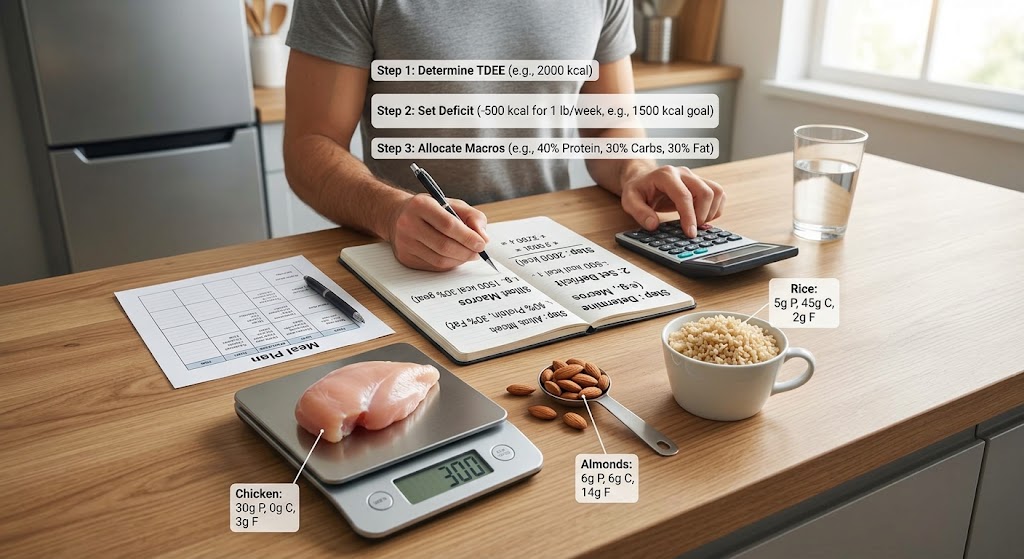
- Your actual BMR (basal metabolic rate) — the Mifflin-St Jeor equation, not a flat estimate
- A healthy BMI range adjusted with Indian population data in mind, not a single number
- Your TDEE (total daily energy expenditure) based on real activity level, not a guess
- A safe weekly rate of change — 0.5 kg/week for fat loss, slower and more conservative for muscle gain
- A week-by-week timeline, so you know what a realistic month 1, month 2, and month 3 look like — not just an end date
Once these five numbers are in place, "ideal weight" stops being a guess and becomes a plan you can actually follow and adjust. This is exactly what we built into the free Ideal Weight & Timeline Calculator — enter height, weight, age, and goal, and it returns a target range, a safe weekly rate, and a full chart of the journey. No signup, no email capture, under a minute to use.

Take someone we'll call Rohit, 34, working a desk job in Pune. He'd tried three different diet plans in two years, each time chasing a weight he'd seen on a chart — 68 kg, because that's what a random calculator once spat out for his height. He never got there, and every failed attempt made the next one feel more pointless.
When he ran his numbers properly, his actual healthy BMI range came out to 66-71 kg — meaning the number he'd been chasing was already inside a normal range, just not the exact middle of it. His real issue wasn't the target. It was that he had no timeline and no idea what a sustainable weekly rate looked like, so every plateau felt like failure instead of a normal part of the process.
Once he had a realistic 14-week timeline and a 0.4 kg/week pace (his TDEE was on the lower end, so a full 0.5 kg/week would have meant an unsafe calorie floor), he stopped panicking at weekly fluctuations and actually finished a cut for the first time.
A target weight without a timeline is just a wish. A timeline without a safe rate is just a countdown to burnout.
What a proper target actually accounts for
- Muscle mass — two people at the same height and weight can look completely different, and a scale-only target ignores this entirely
- Activity level — a desk job and a physically active job produce very different TDEEs even at identical bodyweight
- Age — BMR drops gradually with age, so a 40-year-old and a 22-year-old at the same stats need different calorie targets
- Starting point — someone 20 kg over a healthy range needs a phased approach, not one aggressive push to the finish line
Common mistakes people make chasing a number
- Picking a single target weight off a chart instead of a healthy range — one number is rarely realistic for every body shape
- Ignoring muscle mass entirely and treating the scale as the only source of truth
- Setting a deadline that's too aggressive, which usually means crash dieting and rebound weight gain within weeks of hitting the goal
- Recalculating the target every time the scale moves day-to-day, instead of trusting the original range and rate for several weeks at a time
- Comparing progress to someone else's timeline instead of their own TDEE and starting point
How to know your plan is actually working
- Weekly average trending in the right direction — not a single day's number, which fluctuates with water and food weight
- Waist measurement shrinking even on weeks the scale doesn't move much
- Energy levels staying stable rather than crashing — a sign the calorie floor hasn't been crossed
- Clothes fitting differently before the scale reflects it
FAQ
Is BMI even accurate for Indians?
It's a reasonable starting point but not perfect for anyone — it doesn't account for muscle mass. That's why Indian guidelines shift the overweight cutoff down to 23, and why a healthy range (not a single number) is more useful than a raw BMI score alone.
How often should I recalculate my target?
Every 4-6 weeks, or after a meaningful weight change (3+ kg). Recalculating daily just adds noise — your TDEE doesn't shift that fast.
What if I hit a plateau before reaching my target?
A plateau of 2-3 weeks with no movement despite consistency usually means your TDEE has dropped as you've gotten lighter. Recalculate rather than cutting calories further on your own — an unplanned deeper cut is how the calorie floor gets crossed and energy crashes.
Putting it together: your first 30 days
- Week 1 — Run the calculator, get your range and rate, start logging food roughly (doesn't need to be perfect)
- Week 2 — Adjust portions based on real intake vs. target, not guesses
- Week 3 — Take a waist measurement and a photo alongside the scale weight — three data points, not one
- Week 4 — Compare your actual weekly average to the predicted rate; recalculate only if it's meaningfully off
A calculator gets you the number and the timeline. What it can't do is build the meal structure and training plan that get you there when life gets in the way — a busy week, a wedding season, a plateau that shakes your confidence.
If you want that built for you — a diet plan matched to Indian food, a workout split for your equipment, and a coach on WhatsApp to keep you accountable — check our 12-week program. It picks up exactly where the calculator leaves off.