Home Workout vs Gym: Which Is Better for Beginners?
The "best" workout setup is the one you'll actually use for months. Here's how to honestly decide between home and gym training.
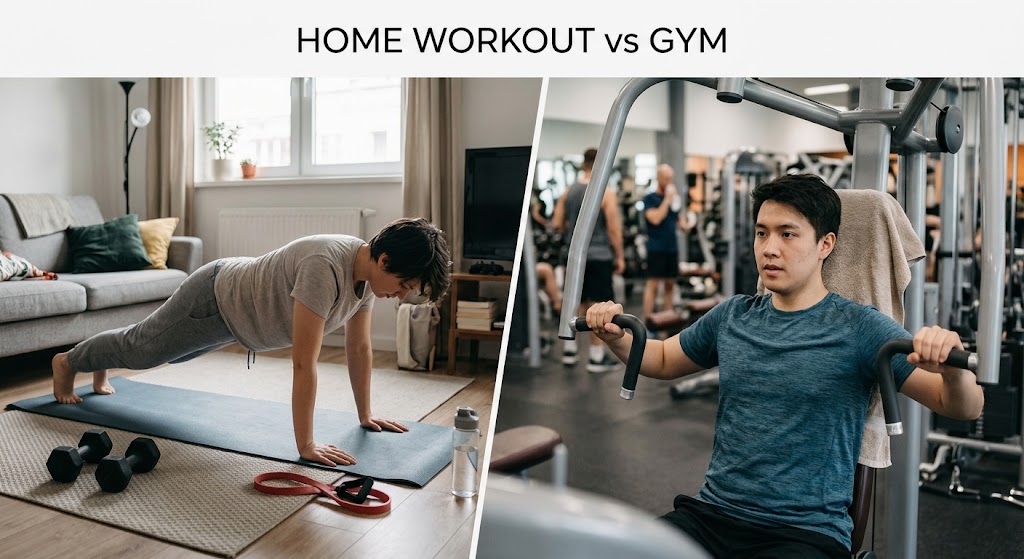
The home workout versus gym debate gets treated like a competition with a clear winner, when the honest answer depends entirely on what predicts whether you'll actually keep training six months from now. Both build real strength and drive real fat loss. The one that wins for you is the one that removes more friction from your week, not the one with more equipment or a nicer setup.
What each option actually offers
A gym gives you access to a wider range of equipment — barbells, machines, heavier weights than most people can justify buying for home — which makes it easier to keep progressively increasing resistance over months and years. It also removes distractions; for many people, a dedicated space with nothing else going on helps them focus and train harder than they would at home surrounded by daily-life reminders.
Home training removes travel time, membership cost, and the social friction some people feel walking into a gym as a beginner. It's also far more flexible — a 20-minute session squeezed between other commitments is realistic at home in a way it often isn't when a commute is involved. The tradeoff is a lower equipment ceiling and, for some people, more distractions and less accountability without others around.
The single biggest factor in results isn't the location — it's whether the setup lets you train consistently for months without excuses piling up. A perfect gym routine you do twice before quitting delivers nothing. An imperfect home routine you do three times a week for a year delivers real, visible results.
How to decide honestly
- Be honest about your actual weekly time and whether a commute fits in it
- Consider cost — gym memberships add up, but so does home equipment over time if you keep buying more
- Think about whether you focus better away from home or don't mind training around daily distractions
- Consider whether you want a wider range of heavier equipment for long-term progression
- Factor in whether being around other people training motivates you or makes you self-conscious
There's no universally correct answer here — the right choice is specific to your actual life, not to what's generally recommended online.
The best workout is the one that survives a busy week, not the one that looks best on paper.
Building real progression at home
The biggest long-term limitation of home training isn't the first few months — bodyweight training alone is enough to build meaningful strength for a beginner. It's what happens after bodyweight exercises stop being challenging. At that point, a resistance band, a couple of adjustable dumbbells, or a doorway pull-up bar extends the runway significantly without requiring a full home gym. Many people can train effectively at home for a year or more with a modest, inexpensive equipment setup before genuinely needing gym-level resistance to keep progressing.
Building real progression at the gym
A gym's advantage compounds over time rather than showing up immediately. In the first few months, a beginner following a sound bodyweight or light-dumbbell program at home will progress at a similar rate to someone doing a structured gym program. The gap widens later, once heavier, more varied resistance becomes the limiting factor for continued strength and muscle gains — which is usually somewhere past the six-month to one-year mark for someone training consistently.
A hybrid approach works for many people
It doesn't have to be an exclusive choice. Some people train at home most of the week and use a gym once or twice for heavier compound lifts. Others use a gym during the week and do lighter home sessions on weekends when time is tighter. The rigid either-or framing that shows up online rarely matches how people actually train successfully over years.
The cost comparison people usually get wrong
Gym memberships come with a predictable, visible monthly cost, which makes them feel like the more expensive option by default. Home training often looks free at first, but the cost tends to arrive gradually — a mat, then resistance bands, then dumbbells, then heavier dumbbells, then maybe a bench — and can add up to a similar or even higher total over a year or two, just spread out less visibly. Neither option is automatically cheaper; the real comparison depends on how much equipment your training actually ends up requiring and how consistently you use whichever option you choose. A membership paid for but rarely used is the most expensive outcome of all, regardless of the sticker price.
What actually determines long-term consistency
Across both settings, the same handful of factors predict whether someone keeps training months later: how much friction stands between deciding to train and actually starting, whether the environment feels comfortable rather than intimidating, and whether progress is visible enough to stay motivating. A five-minute setup time at home removes one kind of friction; a gym's equipment variety removes another kind by keeping training interesting over the long run. Matching the setup to whichever friction points affect you personally matters more than any general ranking of one option over the other.
Common mistakes
- Choosing a gym membership out of obligation while knowing realistically you won't go — fix: pick the option that matches your actual habits, not your aspirational ones
- Buying a full home gym setup before confirming you'll train consistently — fix: start with minimal equipment and add only once bodyweight training plateaus
- Assuming home workouts can't build real strength — fix: bodyweight and light-resistance training is genuinely effective for a long stretch, especially for beginners
- Switching between home and gym constantly without giving either a fair trial — fix: commit to one setup for at least 6-8 weeks before reassessing
- Ignoring travel time and cost as real barriers to consistency — fix: weigh them as seriously as the quality of the equipment itself
How to know your choice is working
- You're actually completing planned sessions most weeks, not skipping them regularly
- Strength and reps are progressing over weeks, regardless of setting
- The routine fits your schedule without constant rearranging or stress
- You're not dreading sessions because of the environment itself
Minimal equipment that extends home training the furthest
If you do decide to invest in home equipment, a small, deliberate list goes further than people expect: a set of adjustable dumbbells, a couple of resistance bands of different strengths, and a stable surface for step-ups or elevated push-ups. This combination covers the large majority of exercises needed to keep progressing well past the point where pure bodyweight training plateaus, without the cost or space commitment of a full home gym setup.
FAQ
Can I build real muscle at home without a gym? Yes, especially in the first several months of training. Bodyweight training combined with basic resistance tools like bands or adjustable dumbbells is enough to build meaningful strength and visible muscle for most beginners.
Is a gym necessary eventually? Not necessary, but useful for continued progress once bodyweight and light-resistance training stop being challenging — typically somewhere past six months to a year of consistent training, depending on the individual.
What if I can't afford a gym membership or home equipment? Bodyweight training alone — squats, push-ups, lunges, planks, and similar movements — is a completely legitimate starting point requiring zero equipment or cost, and it builds a genuine strength base.
Does training at home mean I'll get worse results than at the gym? Not necessarily. Results depend far more on consistency, effort, and progression than on location. A consistent home routine will outperform an inconsistent gym membership every time.
Beginners specifically tend to do better starting at home
For someone brand new to structured training, starting at home for the first several weeks has a quiet advantage: it removes the added pressure of learning gym etiquette, equipment layout, and unfamiliar movements all at once in a public setting. Building basic strength, movement confidence, and a consistent habit at home first, then moving to a gym once the fundamentals feel comfortable, is a reasonable and common path — not a lesser one — for anyone who finds the idea of walking into a gym as a total beginner intimidating enough to delay starting altogether.
Putting it together
- Choose based on what fits your actual weekly schedule and habits, not an ideal version of your life
- Start with minimal equipment if training at home, adding only as needed
- Commit to one setup for 6-8 weeks before reconsidering
- Track reps and progression regardless of setting
- Consider a hybrid approach if it genuinely fits better than an exclusive choice
Neither option is objectively better — the one you'll actually stick with is. If you want a structured plan that works whether you're training at home or in a gym, with a coach guiding your progression, check our 12-week program.