AI Wrote Your Workout Plan. Should You Use It?
AI-generated workout plans are everywhere in 2026. Here's what they get right, where they fail, and how to use one as a template instead of a coach.
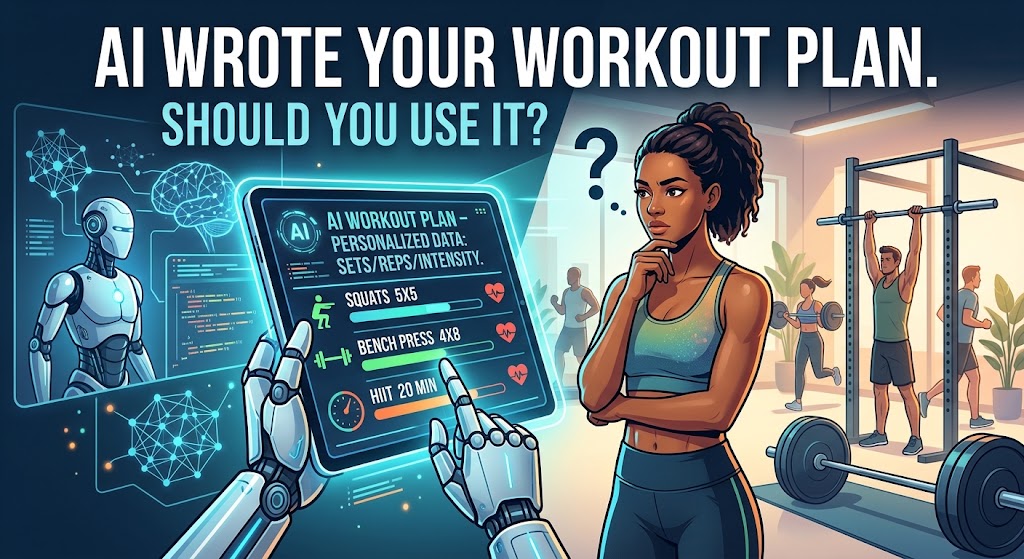
Type "workout plan" into ChatGPT or Gemini and you'll have a 12-week program in eight seconds — sets, reps, exercise names, even a motivational sign-off. It looks complete. It looks free. And for a huge number of people trying it in 2026, it's quietly not working, either stalling their progress or getting them hurt. Here's what AI programming actually does well, where it breaks down, and how to use it without becoming its next cautionary tale.
Why everyone's asking this question right now
Search interest in "AI workout plan" has climbed sharply as general-purpose chatbots got good enough to sound convincing on fitness. It's a reasonable thing to try — coaching is expensive, AI is free or cheap, and the output reads like something a real trainer would write. The problem isn't that AI can't produce a workout. It's that a workout plan and a training program are not the same thing.
A workout plan is a list of exercises for a day. A training program is that list adjusted week over week based on how your body is actually responding — and that adjustment is the part AI can't do without you doing most of the work for it. The chatbot doesn't see your form, doesn't know your last set was a genuine failure or your quads just gave up mentally, and doesn't remember three weeks from now that you tweaked your lower back on the last leg day unless you type that in every single time.
What AI actually gets right
- Generating a structured starting template fast. For a total beginner with no idea where to start, an AI-generated push/pull/legs split beats no plan at all, and beats a randomly assembled Instagram routine.
- Explaining exercises in plain language. Ask it what a Romanian deadlift is or why your program has a deload week, and it usually gives a clear, accurate answer — this is genuinely useful for beginners.
- Building a rough calorie and macro starting point. Basic Mifflin-St Jeor style calculations are well within what these tools do reliably.
- Swapping exercises for equipment limits. "I don't have a barbell" or "my gym has no lat pulldown" gets a sensible substitution almost every time.
- Keeping you company on the accountability side. Some people genuinely train more consistently just from having something that "checks in," even if the checking-in is shallow.
None of this is nothing. For a first program, especially for someone who'd otherwise not train at all, AI-generated structure beats paralysis.
Where it breaks down
- It can't see your form. A squat that looks fine in your head and one an AI would approve of from a text description can still be loading your lower back wrong — and that's exactly the injury AI-guided beginners report most.
- It doesn't adjust for real fatigue. A program that says "add 2.5kg every week" doesn't know you slept four hours last night or you're two weeks into a stressful project at work. Real coaches deload; static AI plans don't, unless you remember to ask.
- It has no memory of your actual sessions unless you feed it every single one. Progressive overload requires knowing exactly what you lifted last time — most people don't log every set into a chat window for 12 weeks straight, so the "progression" quietly stops progressing.
- It can't tell you're plateauing versus injured versus just tired. A human coach who's watched hundreds of clients recognises these patterns quickly. A chatbot treats every "I'm not seeing results" the same way — with generic advice to eat less or lift more.
- It has no accountability mechanism. Nobody's checking whether you actually did the session. For most beginners, that's the single biggest reason plans fail, and AI does nothing to fix it.
AI can write you a program. It can't watch you do it, remember what happened, or notice when something's wrong.
A real example
Ankit, 27, Hyderabad, built himself a 12-week AI-generated hypertrophy program in January — genuinely well-structured, sensible split, progressive overload written into the plan. By week five he'd stopped adding weight because the plan told him to "increase load if the previous week felt manageable," and every week felt manageable because his form on the lift that mattered most — his deadlift — had quietly broken down, turning it into more of a stiff-leg row. Nobody caught it because nobody was watching. He describes plateauing for six weeks before a friend at the gym pointed out the form issue in about ninety seconds of watching one set.
How to use AI as a template, not a coach
- Use it to generate your starting split and exercise list — this is the part it's genuinely good at.
- Film your own sets on the big lifts (squat, deadlift, overhead press) and compare against reputable form-check content, or better, get one in-person or video form check from an actual coach early on.
- Log every session yourself in a notebook or app — AI-driven progression only works if you're the one tracking what actually happened.
- Reassess the plan every 3-4 weeks, not passively — ask yourself explicitly whether you're getting stronger, not just whether you're tired.
- Treat any AI claim about your specific injury risk, medical condition, or pain with real skepticism — this is exactly where generic advice can hurt you.
- If a lift plateaus for more than 3 weeks with proper form, that's the moment to get human eyes on it, not to ask the chatbot to try harder.
AI versus a human coach: what you're actually paying for
The honest cost comparison isn't "free AI plan" versus "expensive coach" — it's what each one is actually doing for the money. A free AI plan gives you exercise selection and a rough progression scheme. A coach's fee, even a modest one, is mostly paying for the things AI structurally can't do: watching your form live or on video, remembering your specific injury history without being re-prompted every session, noticing a plateau pattern across weeks instead of one conversation at a time, and adjusting the plan based on how you actually performed, not how you say you feel in a text box.
For some people — experienced lifters who already know their form is solid and just want a structured template — that gap doesn't matter much, and a free AI plan is genuinely enough. For beginners, anyone coming back from injury, or anyone who's tried and failed with self-directed plans before, the gap is usually exactly where things go wrong. It's worth being honest with yourself about which category you're in before deciding an AI plan alone is sufficient.
Newer camera-based form-check apps are starting to close part of this gap — pointing your phone at yourself during a set and getting automated feedback on bar path or depth. These are a genuine step up from a text-only chatbot and worth using if you have access to one, but they're still pattern-matching against averages, not a person who knows your specific history and has watched you move over time.
Common mistakes people make with AI programming
- Never logging sessions, so "progressive overload" never actually progresses. Fix: keep a simple log — exercise, weight, reps — every single session.
- Trusting form descriptions without ever getting a video check. Fix: one honest in-person or video form check in month one catches problems before they compound.
- Treating a static plan as permanent. Fix: revisit and regenerate the plan every 4-6 weeks based on how the last block actually went, not blindly extending it to 12 weeks.
- Asking it to diagnose pain. Fix: any real pain, not normal soreness, goes to a physio or doctor — not a chatbot.
- Copy-pasting a plan built for someone else's goals. Fix: be specific about your actual goal, equipment, schedule, and experience level every time you generate a new plan — vague prompts produce generic, often mismatched output.
How to know it's working
- Your logged weights on main lifts are trending up over 4-6 week blocks, not flat.
- You've had at least one real-person form check on your biggest lifts.
- You're not skipping sessions more than once every couple of weeks.
- Soreness and fatigue feel manageable, not compounding week over week.
- You can explain why your program is structured the way it is — if you can't, you're following it blindly, which is when injuries and plateaus creep in unnoticed.
FAQ
Is an AI workout plan actually bad, or just incomplete? Incomplete, not bad. As a starting template it's a genuine upgrade over no plan or a copied Instagram routine. It becomes a problem when it's the only input for months with no human check-in, logging, or form review.
Can AI replace a personal trainer? For the programming-on-paper part, partially. For form correction, real-time adjustment, and accountability, no — those require someone actually watching you train, which is the gap most AI-plan injuries come from.
How often should I change an AI-generated plan? Every 4-6 weeks at minimum, based on an honest look at whether your logged numbers actually moved. A plan that hasn't changed in three months because nobody reassessed it is a red flag, not a sign of consistency.
Putting it together
- If you don't have a plan yet, generate one — it beats nothing, and it's a legitimate place to start.
- Start logging every session from day one, even a basic notes-app entry.
- Book one real-person or video form check on your main lifts within the first month.
- Set a calendar reminder to reassess the plan in 4 weeks based on your actual log, not vibes.
- The moment a lift plateaus for 3+ weeks despite good form, get a second opinion from an actual person.
An AI plan can get you started. It can't watch your squat, remember your bad shoulder day, or tell you when to push harder versus back off — the things that actually separate progress from a plateau. If you'd rather have that built in from day one, our 12-week program comes with a real coach on WhatsApp who adjusts your plan as you go, not a static template you're left to interpret alone.