How Many Steps a Day to Lose Weight? (Chart by Body Weight)
10,000 steps is a marketing number from 1960s Japan, not science. Here's how many steps you actually need to lose weight, with a calories-per-step chart by body weight.
Most people trying to lose weight have heard "walk 10,000 steps a day" — and most have no idea where that number came from. It started as the name of a 1965 Japanese pedometer, manpo-kei, which literally means "10,000-step meter." It was a sales slogan, not a research finding. The good news: walking genuinely is one of the most effective, underrated fat-loss tools there is. You just need the real numbers for your body, not a round figure off a box.
The short answer
For most adults, 7,000–10,000 steps a day, combined with a modest calorie deficit, is the sweet spot for weight loss. Below about 5,000 steps a day counts as sedentary. Above 12,000 is great if you enjoy it, but the extra weight loss per extra step gets smaller because most people unconsciously eat a little more.
Steps on their own rarely cause weight loss if your eating stays the same. What steps do brilliantly is make your calorie deficit bigger without making you hungrier — something hard workouts often fail at. If "calorie deficit" is new to you, read Calorie Deficit Explained first; everything below builds on it.
How many calories do steps burn? (Chart by body weight)
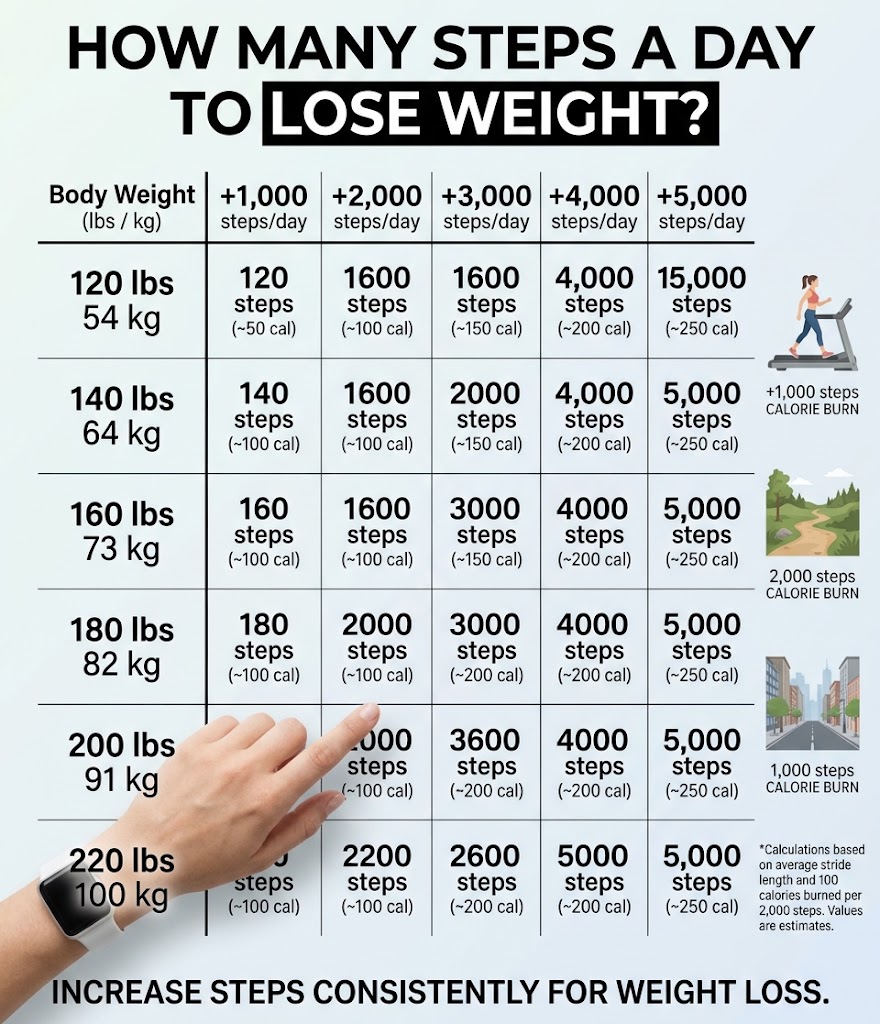
Walking burns roughly 0.04–0.06 calories per step for an average adult, and heavier people burn more per step because they're moving more mass. These are estimates for a normal walking pace (about 3 mph / 5 km/h) on flat ground.
| Body weight | Calories per 1,000 steps | Calories for 10,000 steps |
|---|---|---|
| 120 lb / 55 kg | 28–32 | 280–320 |
| 150 lb / 68 kg | 35–40 | 350–400 |
| 180 lb / 82 kg | 42–48 | 420–480 |
| 210 lb / 95 kg | 49–55 | 490–550 |
| 240 lb / 109 kg | 56–63 | 560–630 |
| 270 lb / 122 kg | 63–70 | 630–700 |
Walking uphill, carrying a backpack, or walking faster (3.5–4 mph / 6 km/h+) pushes these numbers up by roughly 20–40%.
How many steps to lose 1 lb (0.5 kg) a week
A pound of body fat holds roughly 3,500 calories, so losing 1 lb a week takes a daily deficit of about 500 calories. Here's how many extra steps on top of your current average it would take to cover that from walking alone:
- At 150 lb / 68 kg — about 13,000 extra steps a day (too many for most people)
- At 200 lb / 91 kg — about 10,000 extra steps a day
- At 250 lb / 113 kg — about 8,000 extra steps a day
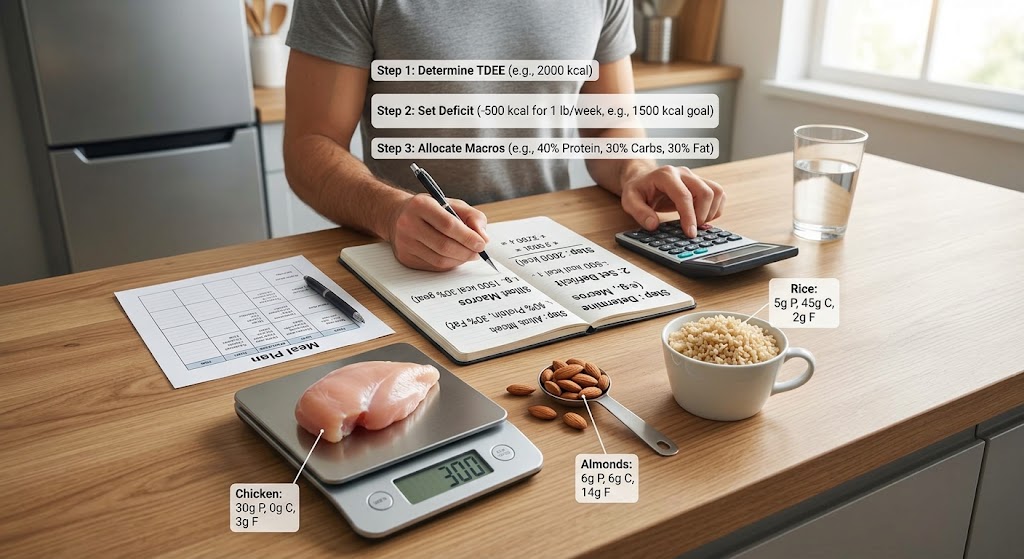
This is exactly why walking works best as half the plan, not the whole plan. Cover 250 calories by walking an extra 5,000–7,000 steps, cover the other 250 by eating a little less, and suddenly 1 lb a week is easy to sustain. To find your actual maintenance number, run it through our BMR & TDEE calculator, then build your daily targets in the calorie and macro planner.
Why walking beats harder cardio for many people
High-intensity cardio burns more per minute, but it also spikes hunger and fatigue, and many beginners compensate by eating more and moving less for the rest of the day. Walking barely touches your appetite, doesn't need recovery days, and you can do it in work clothes.
There's also NEAT — non-exercise activity thermogenesis — the calories you burn from everything that isn't formal exercise. For most people NEAT is a bigger daily calorie lever than the gym. Two people with identical workouts can differ by several hundred calories a day purely through how much they walk around. Raising your step count is the most direct way to raise NEAT.
A one-hour gym session can't undo 23 hours of sitting. Your step count is the other 23 hours.
A real example
Mark, 41, an office worker from Manchester, averaged about 3,500 steps on workdays. He didn't change his gym routine. He added a 20-minute walk at lunch, got off the bus one stop early both ways, and took phone calls standing and pacing. That moved him to about 9,000 steps a day.
He also trimmed one snack a day — no big diet overhaul. Over 12 weeks he dropped roughly 5–7 kg, and his waist came down about two belt notches. The walking didn't feel like "exercise," which is exactly why he kept doing it.
How to add steps without "finding time"
- Walk 10 minutes after each main meal — that's 3,000+ steps and helps blood sugar
- Take every phone call on your feet
- Park at the far end of the car park, or get off transit one stop early
- Use the stairs for anything under four floors
- Set a reminder to stand and walk 250 steps every hour
- Turn one weekly coffee catch-up into a walking meeting
Stack three or four of these and you've added 4,000–6,000 steps without a single dedicated "workout." If you want structured cardio on top, the 12-3-30 treadmill workout is a walking-based routine that burns noticeably more per minute than flat walking.
Common mistakes
- Jumping from 3,000 to 15,000 steps overnight — fix: add 1,000–2,000 per week so your feet and knees adapt
- Eating back the "calories burned" your watch shows — fix: treat watch numbers as rough; they often overestimate by 20%+
- Only walking on weekends — fix: aim for a consistent daily average; consistency beats big days
- Dropping strength training for walking — fix: keep 2–3 strength sessions a week to protect muscle
- Judging progress by the scale in week one — fix: give it 3–4 weeks and track your waist too
How to know it's working
- Your 7-day average step count is consistently above 7,000
- Weekly average weight trending down 0.25–1 lb (0.1–0.5 kg) per week
- Waist measurement down 1–2 cm (about half an inch) within the first month
- Resting heart rate on your watch slowly dropping
- Energy level holding at 6/10 or higher through the afternoon
If weight is stuck despite good step numbers for 3+ weeks, it's almost always the food side — see why you're not losing weight even though you're eating less.
FAQ
Is 10,000 steps a day enough to lose weight? It can be, but only if you're also in a calorie deficit. 10,000 steps burns roughly 300–600 calories depending on your weight. If you eat those calories back, the scale won't move. Combine it with a small food deficit for reliable results.
How long does it take to walk 10,000 steps? About 75–100 minutes total for most people, spread across the day. At a brisk pace, 1,000 steps takes around 8–10 minutes. You don't need to do it in one go — accumulated steps count the same.
Will walking reduce belly fat? Walking reduces overall body fat, and belly fat comes off along with the rest. You can't target one area, but people who walk daily tend to lose visceral (deep belly) fat well. More detail in our guide on how to lose belly fat.
Is walking better than running for weight loss? Running burns more per minute, but walking is easier to do every day and causes fewer injuries. For most beginners, the plan you'll actually stick to wins — and that's usually walking.
Your 4-week step plan
- Week 1 — find your baseline: wear your phone or watch and don't change anything
- Week 2 — add 2,000 steps a day to your baseline using the habits above
- Week 3 — add another 2,000, and add a 10-minute walk after dinner
- Week 4 — hold at 8,000–10,000 and set a small calorie deficit using the calorie and macro planner
Walking is boring in the best way — it's simple, free, and it works when you stop thinking about it and just do it daily. If you'd like a coach to set your step and calorie targets for you and check in on WhatsApp every week, take a look at our 12-week program.