How to Calculate Macros for Weight Loss (Step-by-Step Example)
Forget 40/30/30 templates. Here's how to calculate your own protein, fat and carb targets for fat loss in four steps, with a worked example you can copy.
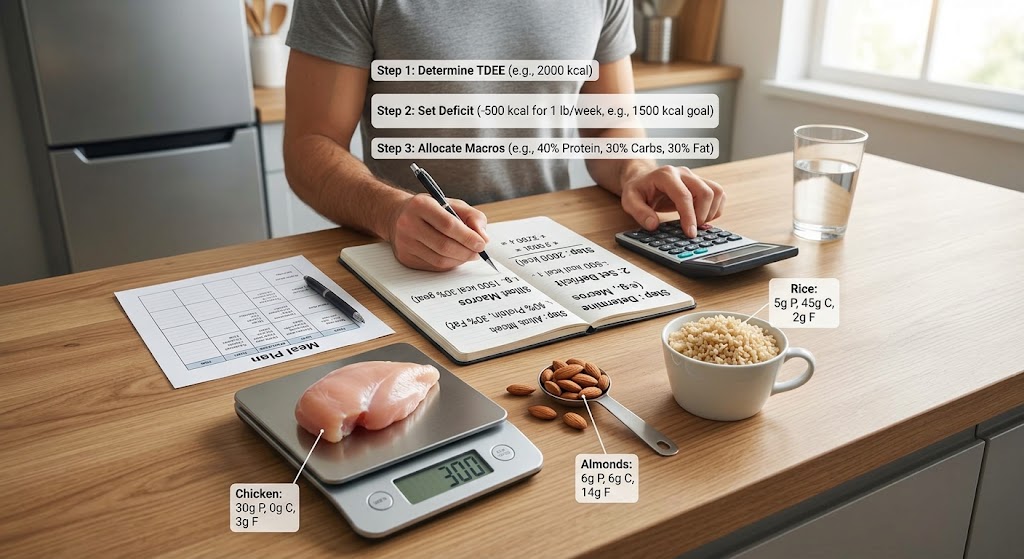
Counting calories tells you how much to eat. Counting macros tells you what that food should be made of — protein, fat and carbohydrates. Two people eating 1,800 calories a day can get very different results: one keeps their muscle and stays full, the other loses muscle and is starving by 4pm. The difference is almost always the macro split. Here's how to calculate your own in four steps, with a worked example you can copy.
Why macros matter for fat loss
Calories decide whether the scale goes down. Macros decide what you lose and how hard the process feels. Eat too little protein in a deficit and a meaningful chunk of what you lose can be muscle — which slows your metabolism and leaves you looking "skinny-soft" instead of lean.
For fat loss, protein is the macro to get right first; fat has a minimum; carbs simply fill whatever calories are left. That one sentence replaces every generic "40/30/30" template on the internet, because it adapts to your body instead of forcing a fixed ratio.
The 4-step macro calculation
- Find your maintenance calories, then subtract 15–20% for your fat-loss target
- Set protein at 1.6–2.2 g per kg of goal body weight (0.7–1 g per lb)
- Set fat at 0.6–1 g per kg of body weight, and never below about 20% of calories
- Give all remaining calories to carbohydrates
Each gram of protein and carbohydrate holds 4 calories; each gram of fat holds 9. That's all the maths you need.
Step 1 — calories. Use our BMR & TDEE calculator to estimate maintenance. A 15–20% reduction is a moderate deficit most people can hold for months. More aggressive cuts lose weight faster on paper but lose more muscle and stall sooner — see how many calories you should eat to lose weight for the full reasoning.
Step 2 — protein. If you have a lot of weight to lose, base protein on your goal weight rather than your current weight, or the number gets unrealistically high. Strength training regularly? Aim for the upper half of the range.
Step 3 — fat. Fat supports hormones and helps you absorb vitamins A, D, E and K. Going extremely low-fat for weeks often backfires with low energy and, for women, irregular cycles.
Step 4 — carbs. Whatever is left goes to carbs. Carbs fuel your training and are not the enemy of fat loss — total calories are.
Worked example
Let's take Jessica, 32, 75 kg (165 lb), 165 cm tall, lifts weights three times a week and walks about 7,000 steps a day. Her goal weight is 65 kg (143 lb).
- Maintenance comes out at about 2,150 calories; a ~18% deficit gives 1,750 calories a day
- Protein: 1.8 g × 65 kg goal weight = 117 g → 468 calories
- Fat: 0.8 g × 75 kg = 60 g → 540 calories (31% of total — fine)
- Carbs: 1,750 − 468 − 540 = 742 calories ÷ 4 = about 185 g
Jessica's daily targets: 1,750 calories — 117 g protein, 60 g fat, 185 g carbs. She doesn't need to hit them to the gram; landing within about 10 g on each macro most days is more than enough.
Want to skip the arithmetic? Our free calorie and macro planner does all four steps for you and lets you adjust the split.
Get protein right, keep fat above the floor, let carbs fill the gap. That's macro counting in one line.
Macro ratios at a glance
If you prefer percentages, these are reasonable fat-loss starting points. Use them as a sanity check on your own numbers rather than a replacement for the four steps.
| Profile | Protein | Fat | Carbs |
|---|---|---|---|
| Woman, beginner, mostly walking | 30% | 30% | 40% |
| Woman, lifting 3–4x a week | 30–35% | 25–30% | 35–45% |
| Man, beginner, mostly walking | 30% | 25–30% | 40–45% |
| Man, lifting 3–4x a week | 30–35% | 25% | 40–45% |
| Prefers lower-carb eating | 35% | 35–40% | 25–30% |
Notice protein barely changes. That's deliberate — it's the macro that protects muscle and keeps you full, so it stays high whatever your preference for fat versus carbs.
How to hit your protein without trying too hard
- Build every meal around a protein source first, then add carbs and veg
- Aim for 25–40 g of protein per meal across 3–4 meals
- Keep easy options on hand: Greek yoghurt, eggs, cottage cheese, tinned tuna, chicken, tofu, lentils
- Use a protein shake as a top-up, not a meal replacement
Most people under-eat protein by 30–50 g a day without realising. If you need ideas, our list of high-protein foods for weight loss covers both vegetarian and non-vegetarian options.
Common mistakes
- Copying someone else's macros from social media — fix: calculate from your own weight and activity
- Setting protein on current weight at 120+ kg — fix: use goal weight to keep it realistic
- Cutting fat to near zero — fix: stay above roughly 20% of calories
- Obsessing over hitting every gram — fix: aim for within 10 g of each target
- Never recalculating — fix: rerun the numbers every 5 kg (10 lb) lost or when weight stalls for 3 weeks
How to know your macros are working
- Weekly average weight falling 0.5–1% of body weight per week
- Strength in your lifts holding steady or improving
- Waist measurement shrinking month over month
- Hunger at a manageable 4–6 out of 10 before meals, not 9
- Energy at 6/10 or better during the afternoon
If the scale stalls for three or more weeks with good adherence, read our guide on how to break a weight loss plateau before cutting further.
FAQ
What is the best macro ratio for weight loss? There isn't one perfect ratio. Total calories drive fat loss; within that, high protein (around 30% of calories or 1.6–2.2 g per kg) works best for keeping muscle and controlling hunger. Split the rest between fat and carbs however you prefer.
Do I need to count macros or just calories? Calories alone will get the scale moving. Tracking protein on top of calories gives most of the benefit of full macro tracking with half the effort, and is a great middle ground for beginners.
Should women have different macros than men? The method is identical — the numbers differ because body weight and calorie needs differ. Women often do well with slightly more fat, especially around their cycle, but protein targets per kilogram are the same.
How often should I recalculate my macros? Every 5 kg (10 lb) of weight lost, or if your weight hasn't moved for 3 weeks despite consistent tracking. A smaller body needs fewer calories, so targets drift over time.
Your 30-day macro plan
- Week 1 — calculate your targets and track everything honestly, without changing food yet
- Week 2 — hit your calorie and protein targets; ignore fat and carbs
- Week 3 — add fat and carb targets, landing within 10 g on each
- Week 4 — review your weekly average weight and waist, then adjust by 100–150 calories if needed
Macros sound complicated, but once you've done the four steps once, it takes five minutes a day. If you'd rather have a coach calculate your macros, build meals around them and adjust as you go on WhatsApp, check out our 12-week program.