Beginner Full Body Workout Plan (No Gym Required)
No gym, no equipment, no confusion. A full body beginner workout you can start today and actually stick with.
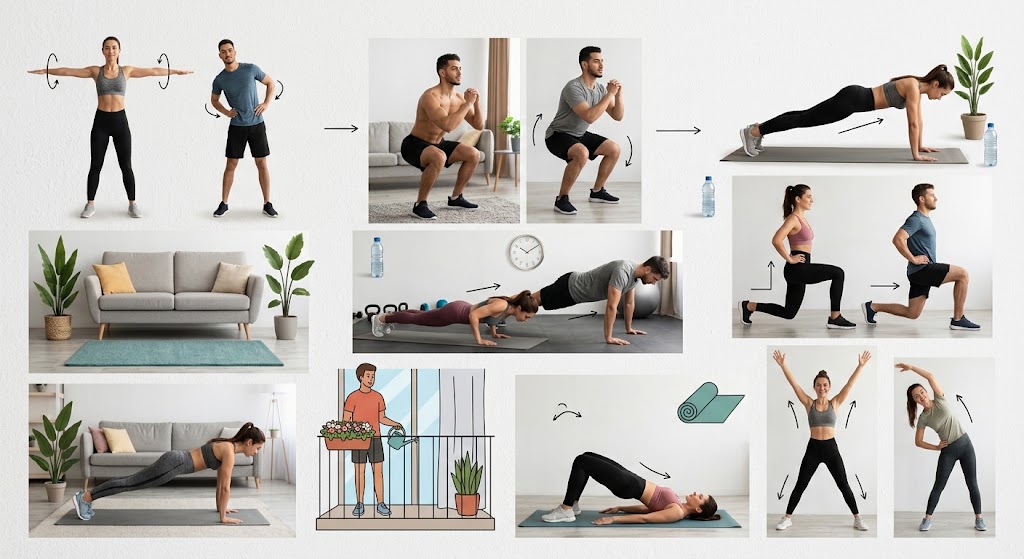
Most beginner workout plans fail for one simple reason: they're built for people who already exercise regularly. Complicated splits, gym-only equipment, and five-day schedules sound impressive but rarely survive contact with a busy, untrained life. A full body routine you can do at home, three times a week, with no equipment, is what actually gets followed long enough to produce results — and results are what keep people coming back once the initial motivation fades.
Why full body beats split routines for beginners
Split routines — chest day, back day, leg day — make sense once you're training 5-6 days a week consistently. For a beginner training 3 days a week, hitting your whole body each session means every muscle group gets trained more frequently, which speeds up early progress. A beginner improves faster training their whole body 3 times a week than training one body part per day. Splits are a tool for later, not a starting point.
There's also a practical reason full body wins for beginners: consistency is harder to maintain than intensity. A 5-day split that gets interrupted by one missed session throws off the whole week's balance — you might hit legs twice and never get to arms. A 3-day full body plan is forgiving. Miss a day, shift the schedule, and nothing falls apart.
The workout
Do this 3 times a week, with at least one rest day between sessions (for example Monday, Wednesday, Friday). No equipment needed — just floor space.
- Bodyweight squats — 3 sets of 12-15 reps
- Push-ups (on knees if needed) — 3 sets of 8-12 reps
- Reverse lunges — 3 sets of 10 reps per leg
- Plank — 3 sets, hold as long as good form allows, up to 45 seconds
- Glute bridges — 3 sets of 15 reps
- Superman hold (lower back) — 3 sets of 10 reps
Rest 60-90 seconds between sets. The whole session takes 30-40 minutes including warm-up.
Form basics for each move
Getting the movement pattern right matters more than the number of reps early on, since poor form both limits results and raises injury risk. For squats, keep your weight through your heels and your knees tracking over your toes rather than caving inward. For push-ups, keep your body in a straight line from shoulders to knees or ankles rather than letting your hips sag. For lunges, keep your front knee roughly over your ankle rather than pushing far forward past your toes. For planks, keep your hips level rather than letting them rise into a peak or drop toward the floor.
None of this needs to be perfect from session one. Recording yourself on your phone for a few reps and comparing it to a reference video is one of the fastest ways to self-correct without needing a trainer in the room.
Warm-up before you start
- 5 minutes of light movement — marching in place, arm circles, hip circles
- 10 bodyweight squats at an easy pace
- 10 slow, controlled arm swings
A rushed warm-up is one of the most common causes of unnecessary soreness and minor strains for beginners. Cold muscles and joints are more prone to being pushed slightly out of their comfortable range, and five minutes of preparation makes a noticeably longer, more comfortable session.
How to progress once it gets easy
- Add reps first — once 15 squats feels easy, aim for 20 before adding difficulty elsewhere
- Slow down the movement — a slower push-up or squat is harder with the same body weight
- Add resistance — a resistance band or a couple of water bottles as makeshift weights
- Add a 4th weekly session once 3 sessions feel comfortably manageable
- Move to a gym-based program with actual weights once bodyweight training stops being challenging
Progression is what separates a workout that works for 6 months from one that stops working after 3 weeks. The body adapts to repeated stress fairly quickly, so a plan with no built-in way to get harder eventually plateaus no matter how consistently you show up.
What soreness means, and what it doesn't
Some muscle soreness in the first couple of weeks, especially after the first session or two, is completely normal and not a sign of damage — it's your muscles adapting to a new kind of stress. It typically peaks around 24-48 hours after training and fades on its own. What isn't normal is sharp joint pain, pain that gets worse rather than better over days, or pain during the movement itself rather than just soreness afterward. Learning that distinction early prevents both unnecessary fear of normal soreness and ignoring a genuine warning sign.
Fitting this into a busy schedule
The biggest obstacle for most beginners isn't the workout itself — it's finding 30-40 minutes three times a week around work, family, and everything else competing for that time. A few practical adjustments make this easier. Training first thing in the morning, before the day has a chance to fill up with other demands, tends to have the highest completion rate for people who struggle with consistency. If mornings genuinely don't work, picking a fixed time slot on the same three days each week — rather than deciding fresh each day whether there's time — removes the daily decision that so often ends in skipping.
It also helps to accept that some weeks won't go perfectly. Two sessions in a busy week beats zero sessions because the third one didn't fit. A missed session doesn't undo progress from the ones you did complete, and the plan is flexible enough to shift days around without losing its structure.
Common mistakes
- Starting with too many exercises and too much volume — fix: stick to this simple list until it's genuinely easy
- Skipping rest days, training every day — fix: muscles grow during rest, not during the workout itself
- Rushing through reps for speed instead of control — fix: slow, controlled movement builds more strength than fast, sloppy reps
- Comparing your week-1 self to someone else's year-3 progress — fix: track your own numbers week over week
- Quitting after a few sessions because "nothing changed yet" — fix: expect noticeable strength gains by week 3-4, visible body changes by week 6-8
- Skipping the warm-up to save time — fix: five minutes upfront saves far more time lost to avoidable soreness or strain
How to know it's working
- Reps that felt hard in week 1 start feeling manageable by week 3-4
- Less soreness after the same workout over time
- Better balance and control during lunges and single-leg movements
- Energy and mood improving on training days
- Everyday movements — stairs, carrying groceries, getting up off the floor — start feeling noticeably easier
What to expect emotionally, not just physically
The first two weeks of any new training routine tend to be the hardest, not because the exercises are especially difficult, but because the habit itself hasn't formed yet. Motivation is highest on day one and tends to dip noticeably by week two, right around when soreness has faded but visible results haven't shown up yet. This gap is where most beginners quit — not from lack of results, but from a lack of results arriving as fast as the initial enthusiasm expected. Knowing this gap is normal and temporary, rather than a sign the plan isn't working, is often the difference between someone who's still training at week twelve and someone who stopped at week three.
FAQ
Do I need equipment to see real results as a beginner? No. Bodyweight training is genuinely enough to build a strength base for the first several months. Equipment becomes useful once bodyweight exercises stop being challenging.
How long before I see visible changes? Strength improvements are usually noticeable within 2-3 weeks. Visible body composition changes typically take 6-8 weeks of consistent training combined with reasonable eating habits.
Is 3 days a week actually enough? Yes, for a beginner. Three focused full body sessions a week, done consistently, outperform a 6-day plan that gets abandoned after two weeks. More frequent training matters much more once you've built a base and progress naturally slows.
Should I add cardio to this plan? It's optional early on. Walking daily alongside this routine is enough for most beginners' health and fat loss goals. Structured cardio sessions become more useful once strength training alone stops driving noticeable progress.
Putting it together
- Do the 6-exercise routine above, 3 times a week
- Warm up for 5 minutes before every session
- Track your reps each week to see progress on paper
- Progress by adding reps, then slowing tempo, then adding light resistance
- Reassess after 6-8 weeks and consider adding a 4th session or moving to weighted training
This is the plan to start with, not the plan to stay on forever. If you want a structured program that grows with you, with a coach guiding your progression on WhatsApp, check our 12-week program.