Creatine for Women: Benefits, Dose, and Does It Cause Bloating?
Creatine is the most researched supplement in sports science, yet most women avoid it because of bloating and "bulking" myths. Here's what it actually does, and how to take it.
Creatine is the most studied supplement in sports nutrition, with hundreds of trials behind it — yet most of that research was done on men, and most women still avoid it. The usual worries are bloating, "bulking up," hair loss, and gaining weight on the scale. Most of those fears are either myths or misunderstandings. Here's what creatine actually does in a woman's body, the right dose, and who benefits most.
What creatine actually does
Your muscles store a small amount of creatine and use it to regenerate energy during short, hard efforts — the last couple of reps in a set, a sprint, a heavy carry. Supplementing tops those stores up, so you can squeeze out an extra rep or two each session. Over weeks and months, those extra reps add up to more strength and more muscle.
Women typically have 70–80% of the creatine stores men do, and eat less of it through diet, which means many women have more room to benefit from supplementing. Vegetarians and vegans start even lower, since creatine comes mainly from meat and fish.
Benefits for women (beyond the gym)
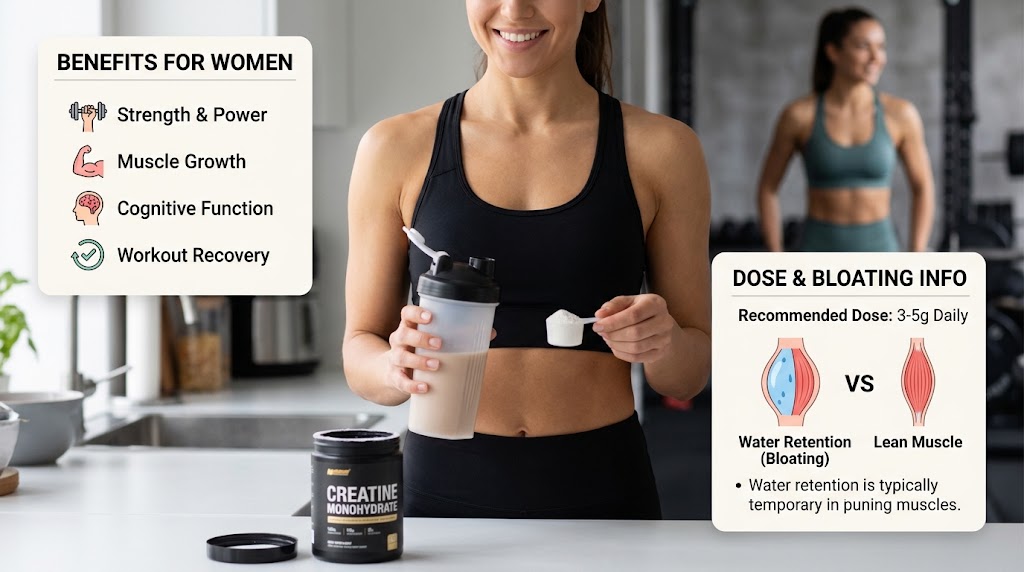
- More strength gain from the same training program
- Better preservation of muscle while dieting for fat loss
- Support for bone density, especially combined with strength training after 40
- Possible improvements in mood and mental fatigue (research is promising, still early)
- Possible cognitive benefits during poor sleep or high stress
The muscle-preservation benefit matters most if you're losing weight. In a calorie deficit your body is tempted to break down muscle along with fat. Strength training plus enough protein is the main defense — creatine adds a small extra layer on top. If your protein is not sorted yet, fix that first with how much protein you need to build muscle.
Women in perimenopause and menopause are an especially interesting group. Falling estrogen accelerates muscle and bone loss, and early research suggests creatine plus resistance training may help slow both. It's not a replacement for medical care, but it's a cheap, well-tolerated addition worth discussing with your doctor.
Will creatine make me bloated or gain weight?
This is the number one fear, so let's be precise. Creatine pulls water into your muscles, not under your skin. Many people see the scale go up by 0.5–1 kg (1–2 lb) in the first few weeks. That's water stored inside muscle tissue — it is not fat, and it usually makes muscles look fuller rather than puffy.
The "bloated" feeling mostly comes from the old loading phase — taking 20 g a day for a week. Large doses can upset the stomach and cause noticeable puffiness. Skip loading entirely. A steady 3–5 g a day reaches the same muscle saturation in about 3–4 weeks with far fewer side effects.
Creatine weight is water inside your muscles, not fat on your waist. Skip loading and most bloating never shows up.
Does creatine cause hair loss?
The hair-loss worry traces back to a single small 2009 study in male rugby players that measured a rise in DHT, a hormone linked to hair loss. It didn't measure actual hair loss, and it hasn't been convincingly replicated. Later research hasn't found that creatine causes hair loss. If you have a strong family history of hair thinning and you're anxious about it, talk to a dermatologist — but the evidence doesn't support avoiding creatine for this reason.
Will it make me bulky?
No. Building a noticeably "bulky" physique takes years of heavy training and eating in a calorie surplus. Creatine helps you get a bit more out of each workout; it doesn't override your calorie intake or hormones. Most women who take it simply notice they get stronger a little faster and look more toned once body fat comes down.
A real example
Emma, 38, from Melbourne, had been lifting three times a week for a year and stalled on her squat and push-ups. She added 3 g of creatine monohydrate daily with breakfast, didn't load, and changed nothing else. Her weight went up about 1 kg in the first month, which nearly made her quit — until her waist measurement stayed the same.
Over the next three months her squat moved up steadily again and she finally got her first set of full push-ups. The scale settled, and photos showed more shape in her arms and shoulders. No bloating, no bulk — just progress restarting.
How to take creatine (the simple way)
- Type: plain creatine monohydrate — the cheapest form is also the best-researched
- Dose: 3–5 g per day (about one level teaspoon)
- Timing: any time of day; consistency matters far more than timing
- Mix with: water, coffee, protein shake or yoghurt — it's tasteless
- Loading: not needed; skip it to avoid stomach upset
- Cycling: not needed; you can take it continuously
Look for third-party tested products (labels such as Informed Sport or NSF Certified for Sport) so you know what's in the tub. Avoid "advanced" blends, liquid creatine and creatine "gummies" with tiny doses — they cost more and often contain less.
Common mistakes
- Quitting after the first-month water weight — fix: track your waist, not just the scale
- Loading with 20 g a day — fix: take 3–5 g daily from day one
- Taking it only on workout days — fix: take it every day so stores stay full
- Expecting it to work without training — fix: pair it with 2–4 strength sessions a week
- Buying fancy blends — fix: plain monohydrate is the gold standard
How to know it's working
- Reps at the same weight go up by 1–2 within 4–6 weeks
- Your estimated 1-rep max climbs month over month
- Waist measurement stable or falling even if the scale rises 0.5–1 kg
- Less "dead legs" feeling on the last set of the session
FAQ
Should women take creatine every day? Yes — 3–5 g every day, including rest days. Creatine works by keeping muscle stores full, which only happens with consistent daily intake. Timing during the day doesn't matter much.
Does creatine help women lose weight? Not directly. It doesn't burn fat. It helps you train harder and keep more muscle while you're in a calorie deficit, which improves how you look and makes it easier to keep the weight off. The deficit itself still does the fat loss — see how many calories you should eat to lose weight.
Is creatine safe for women long-term? In healthy adults, research spanning years at normal doses hasn't shown harm to kidneys or liver. If you have kidney disease, are pregnant or breastfeeding, or take regular medication, check with your doctor first.
When will I notice results from creatine? Without loading, most people notice small strength improvements after 3–4 weeks, once muscle stores are saturated. Bigger visible changes come over 2–3 months of consistent training.
Putting it all together
- Buy plain, third-party tested creatine monohydrate
- Take 3–5 g daily, no loading, any time of day
- Train with weights 2–4 times a week — start with this beginner 4-day split
- Hit your protein target and judge progress by strength and waist, not week-one scale weight
Creatine is cheap, safe for most healthy women, and one of the few supplements with solid evidence behind it — but it amplifies good training, it doesn't replace it. If you want the training and nutrition side built for you, with a coach adjusting it on WhatsApp, check out our 12-week program.