How to Lose Weight After 40: What Actually Changes (And What Doesn't)
After 40, fat loss feels harder — but not for the reason most people think. Your metabolism barely slowed. Here is what genuinely changed, and the plan that works with your body instead of against it.
Everything that worked at 25 stops working at 42. Skip a few meals, walk a bit more, and the weight used to fall off. Now it does not budge — and the belly seems to arrive on its own.
Most people blame a slowing metabolism. The research says that is mostly a myth. Metabolic rate stays remarkably stable from about age 20 to 60, dropping only around 1% per decade once body composition is accounted for.
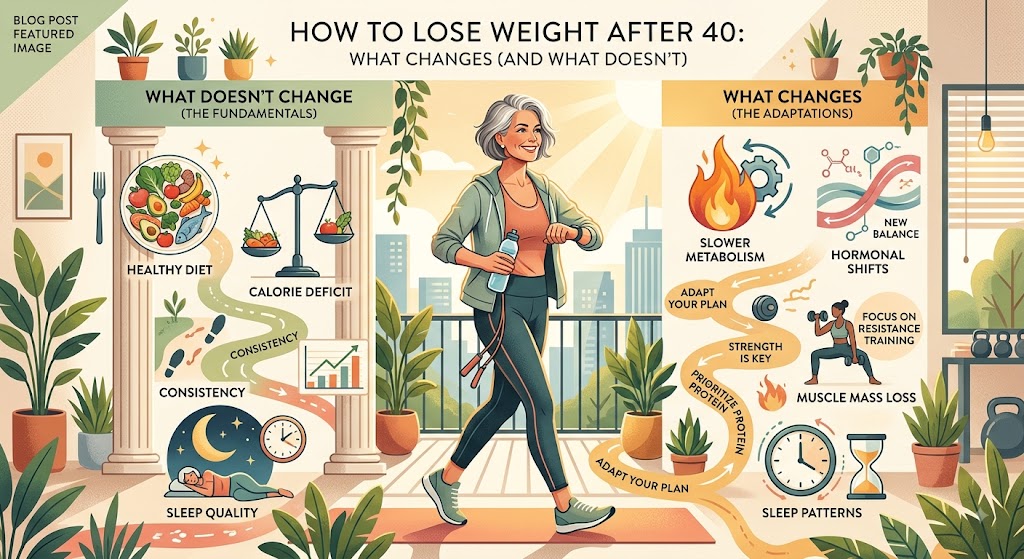
So what actually changed? Four things — and every one of them is fixable.

What Actually Changed After 40
1. You Lost Muscle Without Noticing
From around age 30, adults lose roughly 3–8% of muscle mass per decade if they do not strength train. Less muscle means fewer calories burned at rest, and it means your body stores a larger share of what you eat as fat.
This is the single biggest driver — and it is completely reversible at any age.
2. You Move Far Less Than You Did
At 25 you had a commute on foot, evening cricket, stairs, and general restlessness. At 42 you have a car, a desk, and a laptop at night. That is often 2,000–4,000 fewer steps a day — 200–400 calories, every day, silently.
3. Sleep and Stress Got Worse
Career pressure, kids, ageing parents, and money worries all peak in this decade. Poor sleep raises hunger hormones; chronic stress raises cortisol, which increases appetite and water retention.
4. Hormones Shifted
For women, perimenopause (typically starting in the 40s) shifts fat storage toward the abdomen and can make the scale erratic. For men, testosterone declines gradually, making muscle harder to keep. Real effects — but far smaller than the muscle and movement problems above.
The Plan: Five Priorities in Order
Priority 1 — Strength Train Twice a Week (Non-Negotiable)
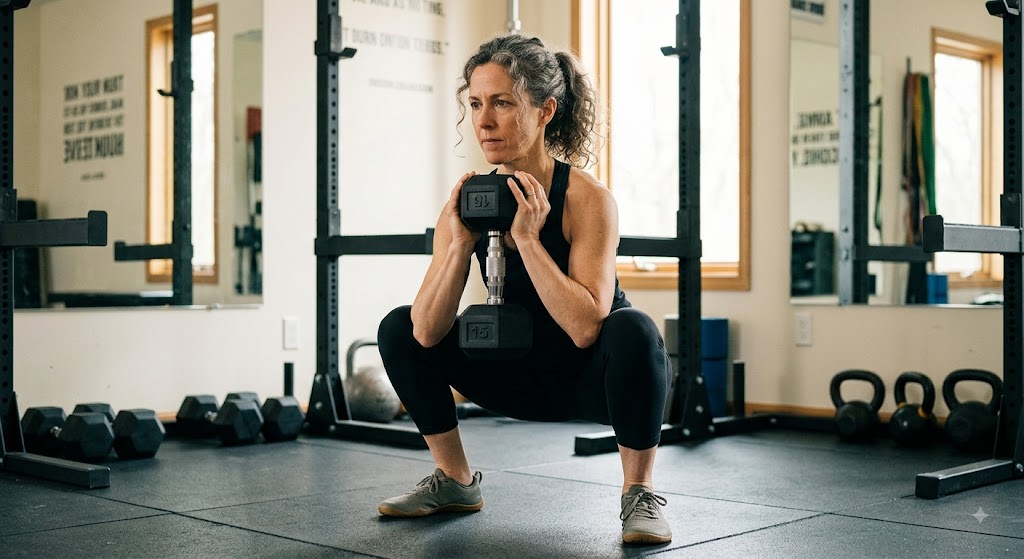
If you do one thing from this article, do this. Strength training rebuilds the muscle that was quietly lost, protects your bones, keeps your metabolic rate up, and makes everyday life easier.
- 2–3 sessions a week, 40 minutes each
- Full body: squat or leg press, a push (push-up / chest press), a pull (row / lat pulldown), a hinge (Romanian deadlift), a carry
- 2–3 sets of 8–12 reps, stopping 2 reps short of failure
- Add a little weight or one rep every couple of weeks — that is the whole method
You are not too old for this. People in their 70s and 80s build measurable muscle with resistance training. No gym? The home workout plan works — just progress it.
Priority 2 — Protein at Every Meal
Older adults need more protein than younger adults to trigger the same muscle-building response, not less. Aim for 1.4–1.6 g per kg of body weight, spread across meals rather than dumped into dinner.
Practically: 25–30 g at each main meal. Eggs, dal plus curd, paneer, soya, chicken, fish. Vegetarian? The 100 g vegetarian protein guide has three full day plans.
Priority 3 — A Moderate Deficit, Not a Crash
A 500 calorie deficit is right. A 1,000 calorie deficit at 45 will cost you muscle, wreck your energy, and worsen the exact problem you are trying to solve.
- Get your maintenance number from the BMR & TDEE Calculator
- Subtract 500
- Target 0.5 kg a week — roughly 6 kg over three months
- Never below 1,200 kcal (women) / 1,500 kcal (men)
Slower is genuinely better here. The goal is to arrive at a lower weight with your muscle intact.
Priority 4 — Walk 8,000+ Steps
Walking replaces the movement that disappeared from your life. It is joint-friendly, does not spike appetite, does not need recovery, and it is the easiest 300 calories a day you will find.
Two 20-minute walks — after lunch and after dinner — get most people there and also help blood sugar control.
Priority 5 — Protect Your Sleep
Seven hours minimum. This is not the soft item on the list — under-slept people eat more, train worse, and lose a greater share of their weight as muscle. Fixing sleep often unlocks a stalled diet on its own.
A Realistic Week
- Mon — Strength (full body) + 20 min walk
- Tue — 8,000 steps
- Wed — Strength (full body)
- Thu — 8,000 steps + mobility/stretching 10 min
- Fri — Strength (full body)
- Sat — Long walk or cycling, 45 min
- Sun — Rest, meal prep for the week
Three lifting sessions, daily walking, one full rest day. That is enough — more is usually counterproductive at this stage of life, because recovery, not effort, is the limiting factor.
What to Expect
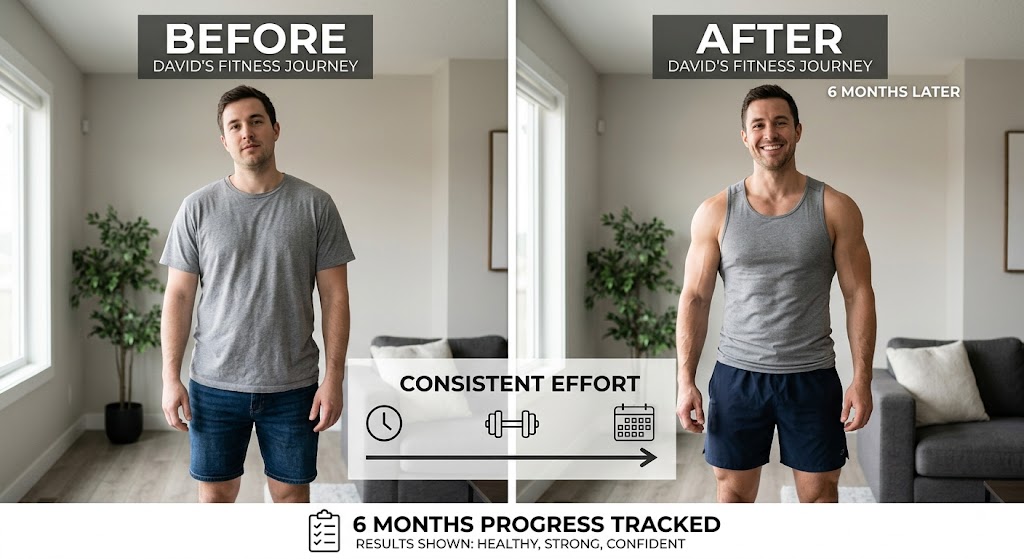
- Weeks 1–4 — 2–3 kg down, strength climbing fast, clothes fitting better
- Weeks 5–8 — 0.4–0.6 kg a week, visible change in the mirror, better energy and sleep
- Weeks 9–12 — 5–7 kg total, noticeably stronger, joints usually feel better than when you started
Joints, Injuries, and Old Problems
A bad knee or a stiff back is a reason to train differently, not a reason to skip training. Strength work usually reduces joint pain over time by strengthening the surrounding muscle.
- Knee pain — leg press and box squats to a comfortable depth instead of deep free squats
- Back pain — trap-bar or Romanian deadlifts with light weight; brace the core, do not round
- Shoulder pain — neutral-grip presses and rows, avoid deep behind-the-neck movements
- Always warm up 5–10 minutes. At 45 this is not optional the way it was at 25.
If something hurts sharply, stop and see a physiotherapist. Working around pain is fine; working through sharp pain is not.
FAQ
Does metabolism really slow down after 40?
Barely. Research shows metabolic rate is largely stable from about age 20 to 60, declining around 1% per decade after accounting for body composition. What actually slows fat loss is lost muscle, reduced daily movement, worse sleep, and higher stress — all of which are addressable.
How much weight can I realistically lose per week after 40?
0.4–0.6 kg per week is the sweet spot. Faster than that after 40 usually means losing muscle, which makes maintaining the loss much harder later.
Is it too late to build muscle at 45 or 50?
No. Adults in their 60s, 70s, and 80s reliably build muscle with resistance training. Beginners over 40 often see the fastest relative gains of their lives in the first six months, simply because they have never trained before.
Why is belly fat specifically harder to lose after 40?
Hormonal shifts — declining oestrogen in women, declining testosterone in men — push fat storage toward the abdomen. You cannot target belly fat directly with exercises, but as overall body fat comes down the abdomen does follow.
Should I do more cardio or more weights after 40?
Weights first, walking second, intense cardio last. Strength training addresses muscle loss, which is the root cause. Walking adds burn without recovery cost. Hard cardio has its place but should not replace lifting.
Where to Go From Here
Want a plan that adjusts as you go? Tracqfit builds your calorie and protein targets from your own numbers and tracks strength and weight together — so you can see that you are losing fat, not muscle.