Hypothyroidism Weight Loss: A Realistic Indian Diet and Workout Plan
TSH in range but the scale won't move? Here's why hypothyroidism breaks generic diet plans, and the Indian meal and training structure that actually works around a slow thyroid.
You're on thyroxine, your TSH is finally in range, and the scale still won't move. Doctors say your levels are "normal" but your energy, your appetite, and your waistline all disagree. Hypothyroidism doesn't make fat loss impossible — it makes the standard advice useless, because your metabolism, hunger signals, and recovery all run slower than a textbook diet plan assumes. Millions of Indian women live with this exact gap between "my labs are fine" and "nothing I do works," and almost none of them are given a plan that actually accounts for it.
Why Standard Diet Advice Fails Here
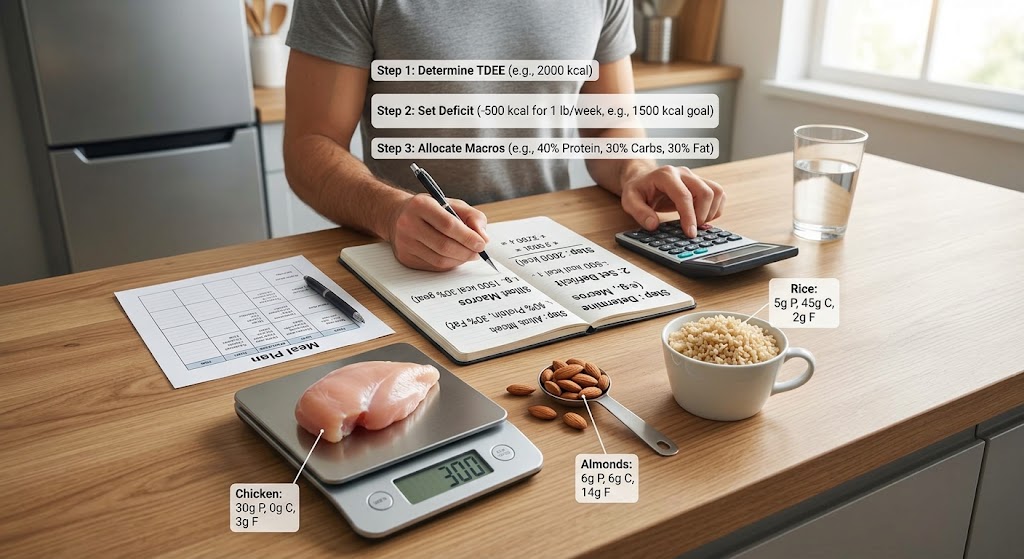
A slow thyroid lowers your resting metabolic rate — the calories your body burns just existing. Generic calculators built for a "normal" metabolism will overestimate what you actually need, so a 500-calorie deficit that should work on paper leaves you stuck or, worse, losing muscle instead of fat.
The fix isn't eating less — it's eating right for a slower engine. That means more protein to protect muscle, smaller but more frequent meals to manage energy dips, and strength training that keeps your metabolism from sliding further.
Untreated or poorly controlled TSH also drives water retention and fatigue that gets mistaken for "laziness." If your labs haven't been checked in the last 3 months, that's step zero — no diet plan outworks an undertreated thyroid.
There's also a psychological trap that's specific to this condition. Because the diagnosis comes with a pill, it's easy to assume the pill alone should fix everything — so when the scale doesn't move, the instinct is to blame the medication or give up on diet and training altogether. In reality, thyroxine restores your hormone levels; it doesn't restore your habits. Both pieces have to be in place.
It also helps to separate two different phases most women go through: the period right after diagnosis, when the dose is still being titrated and everything feels unpredictable, and the stable phase, once your dose has held steady for a few months. Fat loss efforts started during the unstable phase often fail for reasons that have nothing to do with diet — the dose itself is still moving. Waiting for your endocrinologist to confirm a stable dose before starting a structured fat loss push saves months of frustration.
Understanding Your Numbers Before Changing Anything
TSH, free T3, and free T4 are the three values worth tracking, not TSH alone. Two women with an identical TSH can have very different free T3 levels, and free T3 is the more active hormone that drives day-to-day metabolism and energy. If you've only ever seen your TSH number, ask your doctor to include free T3 and free T4 on the next panel — it explains a lot of the "my labs are normal but I still feel awful" experience.
It's also worth ruling out iron and vitamin D deficiency alongside thyroid labs. Both are extremely common in Indian women and both independently cause fatigue that gets blamed on the thyroid when it's really a separate, easily fixable gap.
Building an Indian Diet That Works With a Slow Thyroid
- Anchor every meal around a protein source — dal, paneer, curd, eggs, or chicken — before adding carbs.
- Cut refined sugar and maida (white flour) sharply; they spike insulin faster than your slower system can clear.
- Add iodine-rich, thyroid-friendly foods — curd, eggs, and iodised salt — instead of raw cruciferous vegetables in large amounts.
- Space meals 3-4 hours apart instead of grazing all day, which keeps insulin from staying elevated.
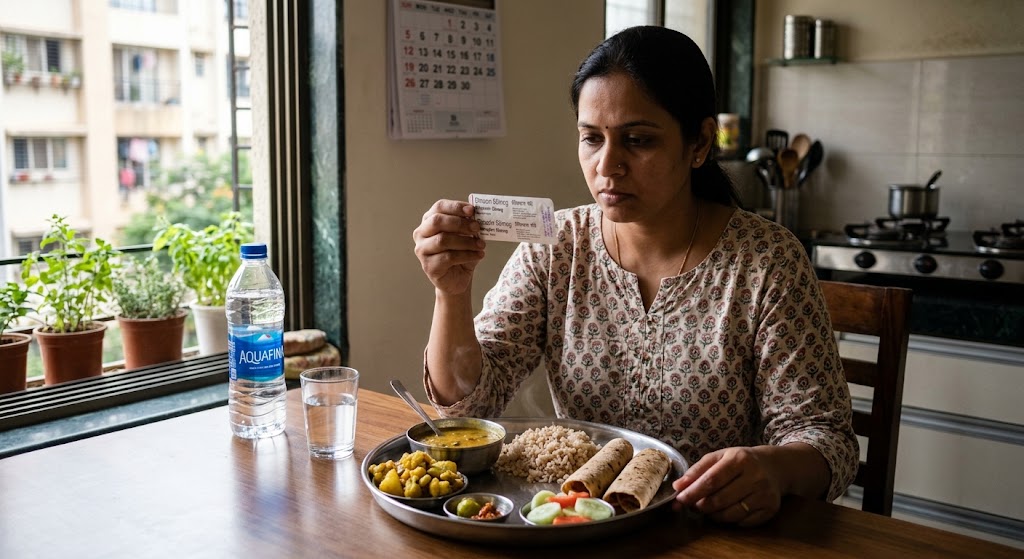
- Take thyroxine on an empty stomach, 30-45 minutes before breakfast, exactly as prescribed — food and even coffee too close to the dose blunts absorption.
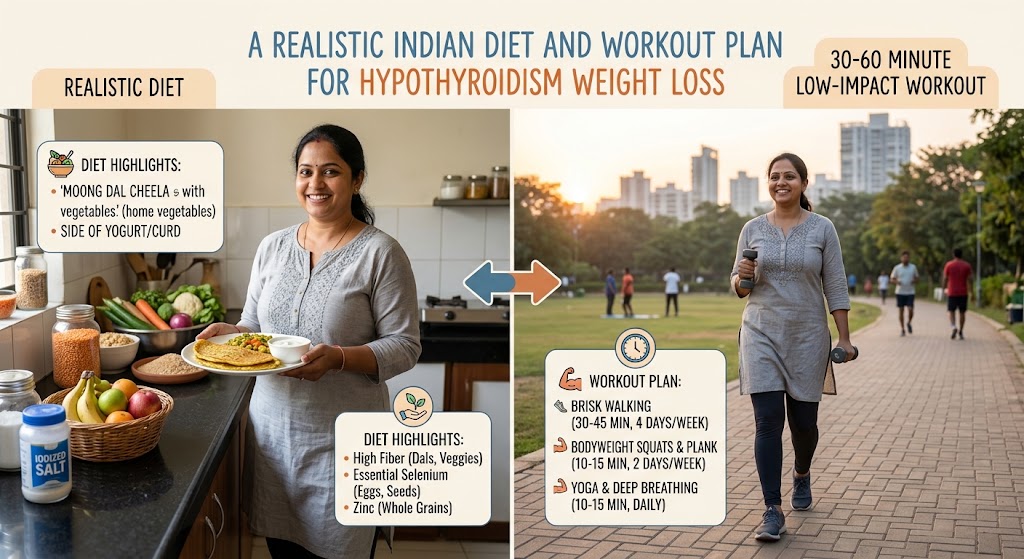
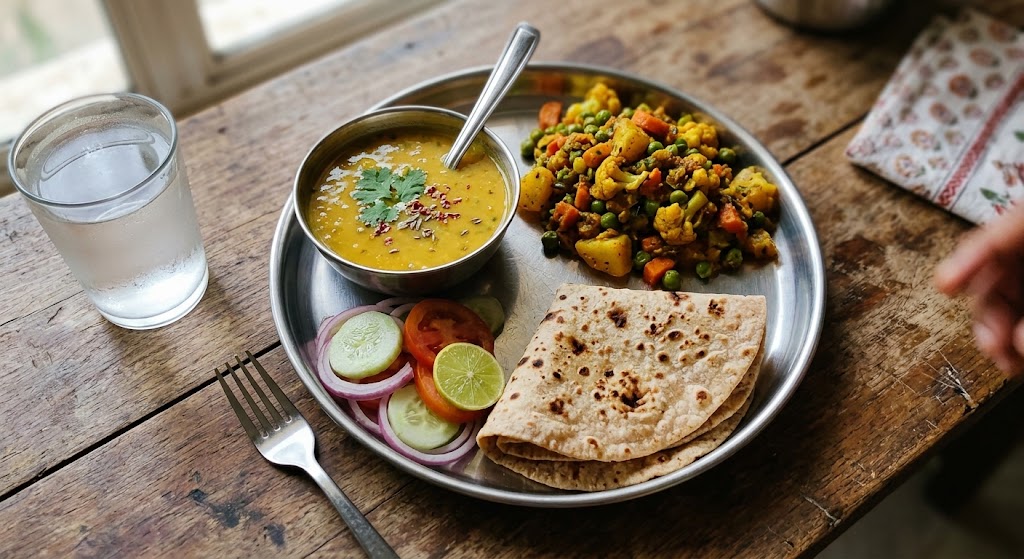
A realistic day looks like: moong dal chilla with curd for breakfast, a dal-sabzi-roti thali for lunch with a bowl of salad first, roasted chana or a boiled egg as an evening snack, and a light dinner of grilled paneer or fish with sautéed vegetables. Nothing exotic — just protein-first, sugar-light, and consistently timed.
Selenium, Iodine, and the Nutrients That Actually Matter
Selenium supports the conversion of T4 into the more active T3 hormone, and most Indian diets get enough of it through everyday foods — mushrooms, dairy, and grains — so a special supplement is rarely necessary. Iodine works the same way: normal use of iodised salt covers the requirement for almost everyone, and adding extra iodine on top without a deficiency can actually worsen thyroid function rather than help it.
This is where a lot of well-meaning advice goes wrong — turmeric shots, coconut oil "cures," and thyroid detox teas sold on Instagram have no real evidence behind them and sometimes interfere with medication absorption. The nutrients that move the needle are boring: enough protein, enough iron, enough vitamin D, and iodine from normal salt use. Nothing sold as a miracle fix belongs in this plan.
Case Study: Meera, 36, Pune
Meera was diagnosed with hypothyroidism at 29 and had tried five diets in seven years, each one stalling within a month. Her labs were technically controlled, but her meals were carb-heavy and irregular, and she wasn't lifting anything heavier than grocery bags.
The change wasn't a stricter diet — it was a simpler one. Protein at every meal, three structured strength sessions a week, and a fixed medication routine 45 minutes before breakfast, no exceptions. Over four months she dropped 6-8 kg and, more importantly, her energy stopped crashing by 4pm.
Her biggest realisation: she'd spent years treating thyroid weight loss as a willpower problem when it was a structure problem. Once the structure was right, the willpower requirement dropped.
What surprised her most was how much the small, boring habit — taking her tablet at the same time every single day, with nothing but water, on an empty stomach — mattered more than any single food swap. She'd been inconsistent with timing for years without realising it was quietly capping how much of her dose her body could even absorb.
A slow thyroid changes how hard you have to work. It doesn't change whether the work pays off.
Training That Doesn't Fight Your Metabolism
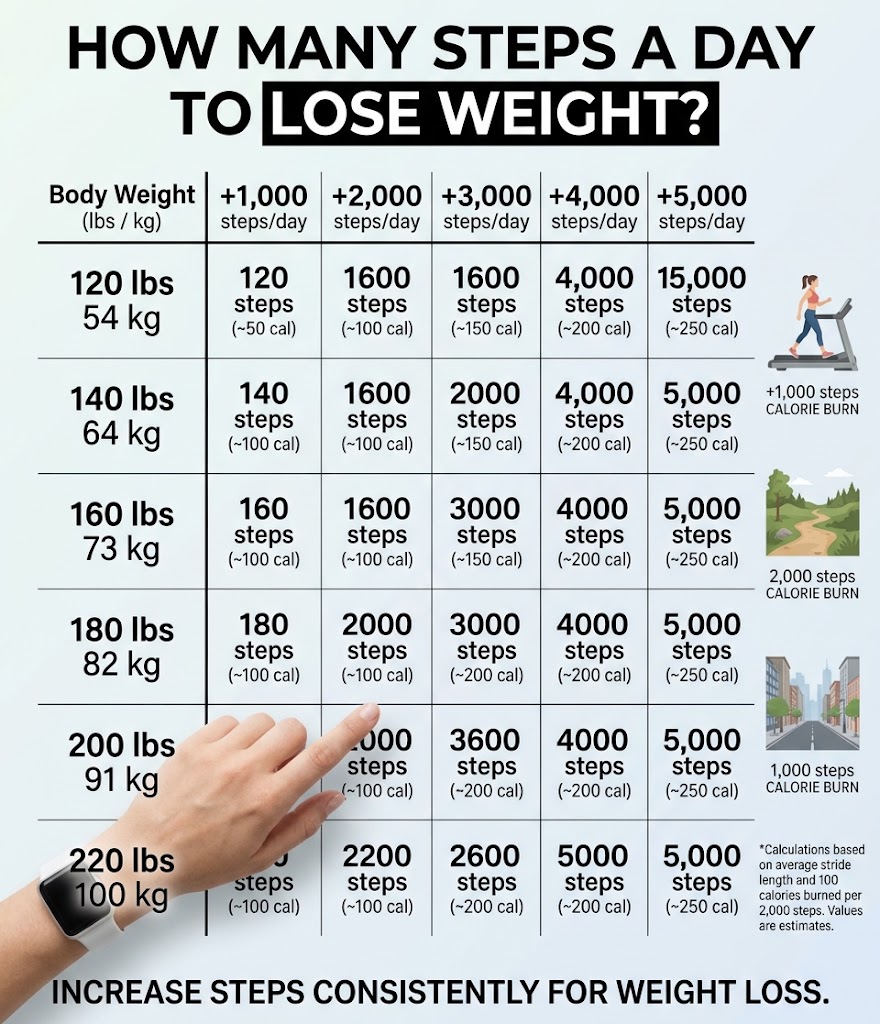
Cardio alone tends to disappoint here — a slower metabolism means fewer calories burned per session, and excessive cardio can add to fatigue that's already elevated. Strength training matters more for hypothyroid fat loss than for almost any other group, because muscle is the one lever that keeps resting metabolism from dropping further.
- 3 full-body strength sessions a week — squats, rows, presses, hip hinges
- One low-intensity walk daily, 30-40 minutes, instead of intense daily cardio
- Prioritise sleep and stress management — cortisol interferes with thyroid conversion in the body
- Track waist and energy, not just the scale — water retention swings the number for reasons unrelated to fat
Common Mistakes
- Chasing a bigger calorie deficit when progress stalls — it usually backfires by increasing fatigue and cortisol. Fix: hold the deficit steady for 2-3 weeks before changing anything.
- Stopping strength training because "cardio burns more." Fix: keep lifting — muscle is what protects your metabolic rate.
- Taking thyroxine with tea, coffee, or breakfast. Fix: water only, 30-45 minutes before food.
- Ignoring stale labs. Fix: recheck TSH every 3 months until stable, then every 6.
- Cutting carbs to near zero. Fix: keep moderate complex carbs — extreme restriction adds stress the thyroid doesn't need.
How to Know It's Working
- Waist measurement trending down over 3-4 weeks, even if the scale is flat
- Energy holding steady through the afternoon instead of crashing
- Strength numbers in the gym slowly climbing, not stuck
- Sleep quality improving rather than needing more hours to feel rested
FAQ
Can I lose weight with hypothyroidism without medication changes?
Only if your levels are already in range. If TSH is still high, talk to your doctor first — diet and training help, but they can't compensate for an undertreated thyroid.
Should I avoid all cabbage, cauliflower, and soy?
Not in normal Indian portions. Goitrogenic effects from cruciferous vegetables and soy are mostly a concern in raw, extreme quantities — cooked and portioned normally, they're fine for most people on stable medication.
How long before I see results?
Expect the scale to move slower than someone without a thyroid condition — often 3-4 weeks before a clear trend appears. Consistency matters more here than almost anywhere else.
Do I need to go gluten-free or dairy-free for my thyroid?
Not unless you have a diagnosed sensitivity or coeliac disease alongside your thyroid condition. Cutting entire food groups without a medical reason usually just makes the diet harder to sustain, without any proven metabolic benefit.
Your 4-Week Starting Plan
- Week 1: fix medication timing and get labs checked if it's been over 3 months.
- Week 2: rebuild every meal around a protein source first.
- Week 3: add 3 strength sessions and 1 daily walk.
- Week 4: review waist and energy trends, not just the scale, before making any changes.
Hypothyroidism makes fat loss slower, not impossible — but it punishes generic plans harder than a healthy metabolism does. If you want this structured for you, with a coach checking in on WhatsApp, our 12-week program builds the meal timing and training around exactly this kind of case, not a one-size-fits-all template.