Losing Weight on Ozempic? You're Probably Losing Muscle Too
GLP-1 drugs like Ozempic and Mounjaro can take up to 40% of your weight loss from muscle, not fat. Here's the protein and training protocol that protects it.
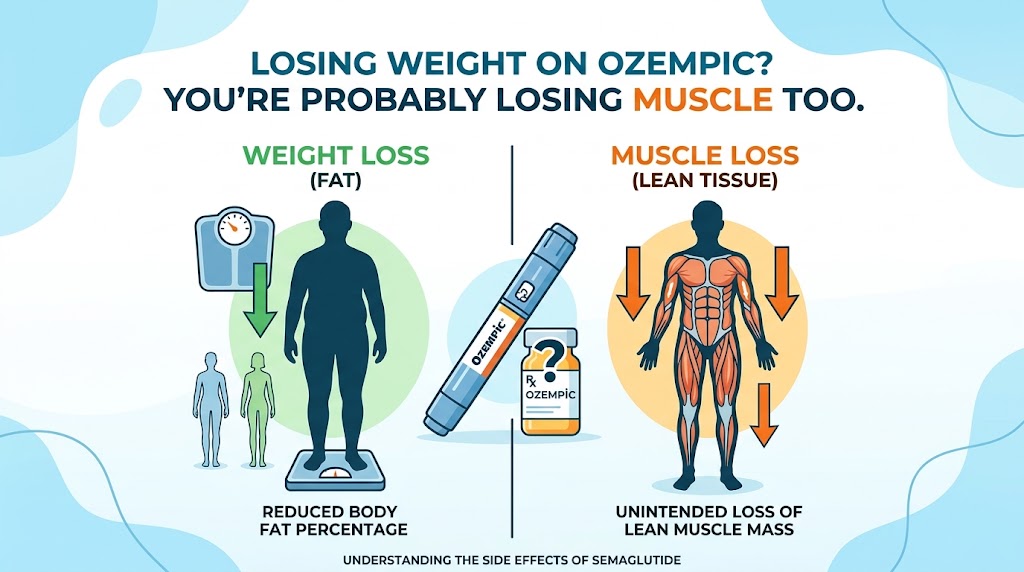
If you've dropped 8-10 kg on Ozempic, Mounjaro, or Wegovy and felt thrilled watching the scale move, here's the number that should slow you down: a meaningful share of that weight isn't fat. Body-composition scans (DEXA) in the major semaglutide and tirzepatide trials found that roughly a quarter to nearly 40% of total weight lost on GLP-1 drugs is lean mass — muscle, not fat. Do nothing about it, and you can finish your course lighter on the scale but weaker, with a slower metabolism than when you started.
Why GLP-1 weight loss is different from a normal diet
GLP-1 receptor agonists — semaglutide and tirzepatide are the two you've probably heard of, sold under brand names like Ozempic, Wegovy, Mounjaro, and Rybelsus — work by mimicking a gut hormone that slows digestion and switches off appetite. That's the whole mechanism. There's no fat-targeting, no muscle-sparing switch. Your body just eats less, across the board, for months.
A normal calorie deficit from dieting alone already costs you some muscle — GLP-1s tend to push that number higher, mostly because appetite suppression is so strong that protein intake quietly collapses. When you're not hungry, you don't reach for the dal, the paneer, the eggs, or the chicken that used to anchor your meals. You eat less of everything, including the nutrient your muscles need most to survive a deficit.
The people at the highest risk are the ones who don't lift weights, eat too little protein because food feels unappealing, and lose weight fast without any resistance training signal telling the body "don't touch the muscle, we still need it."
The 6 changes that protect your muscle on a GLP-1
- Front-load protein before anything else on the plate. With appetite this low, you get maybe three real bites before you're done — make the first bites protein, not rice.
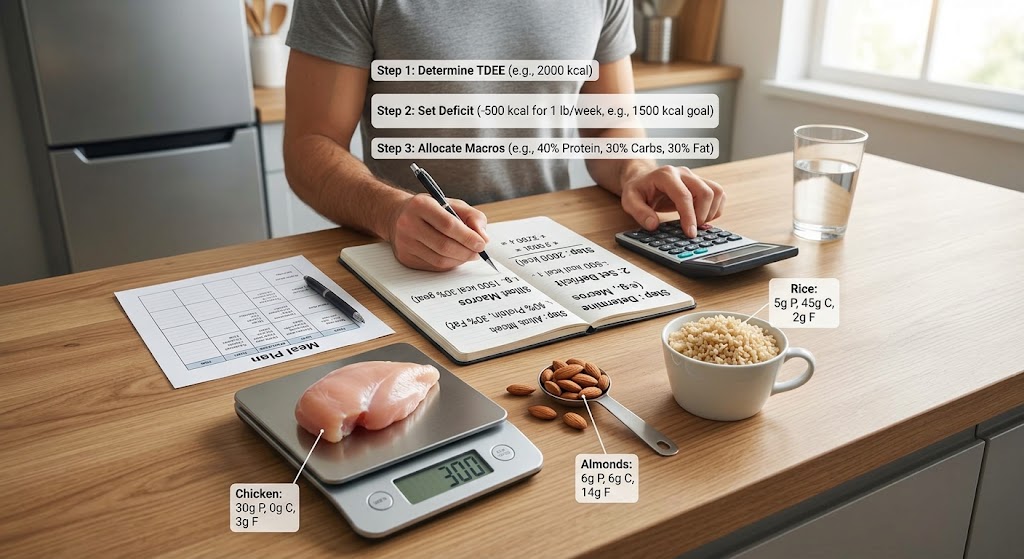
- Set a hard daily protein floor, not a percentage. Aim for roughly 1.6-2.0 g per kg of your target body weight, split across smaller, more frequent meals since large meals may not appeal.
- Lift weights at least twice a week, even on low-energy days. A short, low-volume session still sends the "keep this muscle" signal — you don't need an hour.
- Don't stack cardio on top of the appetite suppression. Extra cardio deepens a deficit that's often already steep because you're barely eating. That's a fast way to lose muscle, not fat.
- Use protein shakes or paneer/curd as backup, not a treat. When solid food feels like too much effort, a shake or a bowl of curd with whey is often the only way the day's protein target gets hit.
- Get bloodwork and a body-composition check before and during treatment, if your doctor offers it. A scale number alone can't tell you whether you're losing fat or muscle — DEXA or even a simple tape-measure + strength log can.
The list above only works if the eating and the lifting happen together. Protein without resistance training still lets some muscle go, because there's no reason for the body to keep tissue it isn't being asked to use. Resistance training without enough protein has nothing to build with. Trainers who work with GLP-1 clients report the same pattern over and over: the people who keep their strength are the ones who treat the drug as an appetite tool sitting on top of a normal training-and-protein plan, not a replacement for one.
What this looks like for a real client
Priya, 34, Mumbai, started semaglutide in her fourth month of a corporate-wellness push, mostly to get past a plateau diet and cardio alone hadn't cracked. Her first two months were rough — appetite gone, barely finishing a tiffin box a day, weight dropping 4-5 kg. She'd stopped going to the gym because she felt too drained. When she added two 30-minute strength sessions a week and made an effort to eat curd, eggs, or a scoop of whey before anything else on her plate, her rate of weight loss slowed slightly — but her waist kept shrinking and her arms stopped looking soft. She describes it as "losing weight slower but looking like I actually lost fat, not just got smaller."
If you're not lifting and not eating enough protein, a GLP-1 will happily take your muscle along with your fat — and it won't tell you until the mirror does.
How to structure training around low energy availability
Training on appetite suppression isn't the same as training normally. Energy is lower, recovery can feel slower, and pushing for exhaustion most days backfires.
- Two to three short strength sessions a week beats five long ones — consistency matters more than volume here.
- Prioritise compound lifts: squats, deadlifts, presses, rows. They recruit more muscle per session than isolation work, which matters when total training time is limited.
- Keep sessions to 30-45 minutes. Long sessions on low food intake risk dizziness and poor form.
- In month one, focus purely on showing up and maintaining current strength — don't chase new personal bests while your body is adjusting to the medication and eating less.
- From month two onward, once appetite and energy stabilise somewhat, you can start progressing load again, gradually.
- If a session feels genuinely too hard because you haven't eaten enough that day, that's a signal to eat, not to push through.
Common mistakes people make on GLP-1s
- Treating it as a free pass to skip protein. Fix: set a non-negotiable protein floor and hit it before carbs or fat, every meal.
- Stopping strength training because energy feels low. Fix: shorten the session, don't skip it — 20 minutes of lifting still protects muscle far better than zero.
- Chasing the scale number instead of body composition. Fix: track waist measurement and a simple strength log (can you still lift what you could last month?) alongside weight.
- Adding extra cardio to "speed things up". Fix: let the appetite suppression do the deficit work; use training time for strength, not more calorie burn.
- Stopping the medication and going back to old eating habits overnight. Fix: any GLP-1 taper needs a plan for reintroducing normal appetite gradually, ideally with your doctor, or the weight (and none of the muscle-protective habits) comes back fast.
- Not telling your doctor you're strength training. Fix: mention it — some dosing and hydration advice changes if you're also lifting.
How to know it's working
- Waist measurement is dropping even when the scale slows down — a sign fat, not muscle, is coming off.
- Your working weights on key lifts are flat or slowly climbing, not falling month over month.
- Energy on non-training days feels manageable, not constantly depleted.
- Protein target is hit on most days, even if total calories are low.
- Clothes fit looser through the waist while shoulders/arms don't look visibly smaller.
FAQ
Will I definitely lose muscle on Ozempic or Mounjaro? Not definitely — but the drug itself does nothing to protect it. Muscle loss on GLP-1s is a function of how little protein you eat and whether you're doing any resistance training, both of which are controllable, not a guaranteed side effect of the medication.
How much protein do I actually need while on a GLP-1? Most guidance lands around 1.6-2.0 g per kg of your target body weight per day, split across more, smaller meals since large meals are often unappealing on these drugs. A registered dietitian can fine-tune this for your specific dose and goals.
Can I still build muscle while losing fat on a GLP-1? It's difficult but not impossible, especially for beginners to strength training or people returning after a long break — "newbie gains" can offset some of the deficit. For most people, the realistic goal is minimising muscle loss, not building new muscle, while the calorie deficit is this steep.
Putting it together
- Set your protein floor this week — write the daily gram target somewhere you'll actually see it.
- Book two strength sessions on your calendar before the week starts, not "whenever there's time."
- Swap one cardio session for a short lifting session if you're currently doing more cardio than strength work.
- Ask your doctor whether a body-composition check makes sense at your next follow-up.
- Re-read this in a month and see if your waist and your lifts moved in the direction you wanted.
None of this is a reason to avoid GLP-1s if your doctor has recommended one — they're a genuinely effective tool for a lot of people. It's a reason to stop treating the injection as the whole plan. If you want the protein targets and training built around your specific dose, appetite level, and schedule instead of figuring it out alone, our 12-week program pairs a coach on WhatsApp with a plan designed for exactly this — no monthly fee, one payment for the full program.