PCOS and Weight Loss: What Actually Helps
PCOS changes the rules slightly, not the whole game. Here's what to focus on when standard weight loss advice isn't working.
PCOS, or polycystic ovary syndrome (also referred to in some places as PMOS), is one of the most common hormonal conditions affecting people of reproductive age, and it's also one of the most frustrating when it comes to weight loss. The standard advice — eat less, move more — still applies, but PCOS changes some of the details underneath it, and understanding those details is what separates a plan that works from one that quietly fights against your biology.
Why PCOS makes weight loss harder
The core issue for most people with PCOS is insulin resistance, where the body needs more insulin than usual to manage blood sugar. Higher circulating insulin promotes fat storage and can increase hunger and cravings, particularly for refined carbs and sugar. This is the biological reason a calorie deficit that would work easily for someone without PCOS can feel like it's barely working — insulin resistance is quietly working against the deficit in the background. It doesn't mean weight loss is impossible. It means the deficit needs more careful planning around food choices, not just total calories.
PCOS is also associated with slower metabolism in some individuals, more fatigue, and disrupted sleep from hormonal fluctuations — all of which make consistent training and eating habits harder to maintain than they would be otherwise. None of this is a reflection of effort or willpower. It's a physiological pattern that responds to a specific approach.
What actually helps
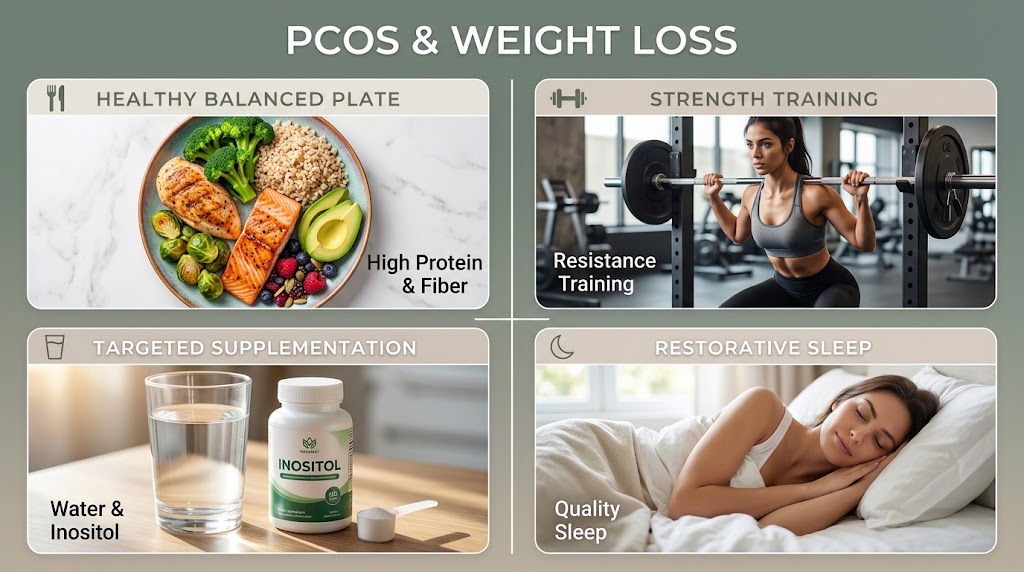
- Prioritize protein and fiber at every meal — both slow digestion and blunt blood sugar spikes
- Reduce refined carbs and sugary drinks rather than eliminating carbs entirely
- Strength train regularly — muscle improves insulin sensitivity independent of weight loss
- Keep a consistent sleep schedule — poor sleep worsens insulin resistance
- Move throughout the day, not just during workouts — short walks after meals help blood sugar control
- Work with a doctor on any medication that affects insulin sensitivity, if prescribed
None of this requires an extreme or restrictive diet. In fact, very low-calorie or very low-carb crash diets tend to backfire for PCOS specifically, since they increase stress hormones that can worsen the underlying hormonal picture.
With PCOS, how you build the deficit matters as much as the deficit itself.
Why carb quality matters more than carb quantity
For most people trying to lose weight, total calories decide the outcome regardless of where they come from. With PCOS, carb quality gets extra weight in the equation because of the insulin connection. Refined carbs — white rice in large portions, sugary drinks, packaged snacks — cause faster, sharper blood sugar spikes, which in someone with insulin resistance can trigger stronger hunger and cravings shortly after eating. Choosing higher-fiber, less processed carb sources — whole grains, legumes, vegetables — produces a gentler blood sugar response, which makes staying in a deficit noticeably easier day to day, even at the same total calorie and carb amount.
This isn't about carbs being "bad." It's about which carb sources make hunger easier or harder to manage for someone with this specific hormonal pattern.
The role of strength training specifically
Cardio has a place, but strength training deserves particular emphasis for PCOS. Building and maintaining muscle improves how efficiently your body uses insulin, independent of any weight lost. This means the benefits of a consistent strength routine show up even before the scale moves — better energy, steadier hunger, and often improved cycle regularity over time, alongside the eventual weight loss itself.
Why crash dieting backfires specifically with PCOS
Very aggressive calorie cuts raise cortisol and physical stress on the body, and elevated stress hormones can worsen insulin resistance — the exact mechanism already working against weight loss in PCOS. This creates a frustrating loop where an extreme diet, intended to speed things up, ends up making the underlying hormonal picture harder to manage, which then makes the diet itself harder to sustain. A moderate, steady deficit avoids adding this extra layer of stress on top of an already sensitive system, which is part of why "slow and steady" isn't just a cliché here — it's a more direct path for this specific condition.
Tracking progress beyond the scale
Because PCOS can cause the scale to move more slowly or unevenly than a standard calorie deficit would predict, relying on it as the only measure of progress often leads to discouragement that isn't warranted. Waist measurement, energy levels, how clothes fit, workout performance, and — where relevant — cycle regularity all give a fuller picture of whether the approach is working. Many people with PCOS notice non-scale improvements well before consistent scale movement, and treating those as real progress rather than dismissing them keeps motivation intact through the slower stretches.
Common mistakes
- Following extremely low-calorie diets expecting faster results — fix: a moderate, sustainable deficit works better and avoids worsening stress hormones
- Cutting out carbs completely — fix: focus on carb quality and portion, not elimination
- Skipping strength training in favor of cardio only — fix: add 2-3 strength sessions a week for the insulin-sensitivity benefit
- Expecting the same rate of loss as someone without PCOS — fix: progress may be slower; consistency over months still works
- Ignoring sleep while focused only on food and training — fix: treat consistent sleep as part of the hormonal picture, not separate from it
- Trying to manage everything through diet alone without medical input — fix: loop in a doctor, especially if insulin resistance or another related condition is confirmed
How to know it's working
- Hunger and cravings between meals becoming more manageable
- Energy levels improving, less of the fatigue crash common with PCOS
- Waist measurement and how clothes fit changing, even if the scale moves slowly
- Cycle regularity sometimes improving over months, though this varies by individual and isn't guaranteed by weight loss alone
- Strength in workouts steadily improving
Building a realistic weekly structure
A practical starting point pairs 3 strength sessions a week with daily walking, meals built around protein and fiber-rich carbs first, and a consistent sleep and wake time even on weekends. None of this needs to be perfect immediately — the priority is a structure simple enough to actually repeat every week, since the compounding effect of consistent moderate habits over months matters more for PCOS specifically than any single "optimal" week done occasionally.
Patience as an actual strategy, not just a mindset
Because insulin resistance can slow the rate of visible progress compared to someone without PCOS, setting expectations around a realistic timeline from the start prevents a lot of unnecessary discouragement later. Where someone without PCOS might see steady weekly movement, someone with PCOS might see the same overall trend unfold more gradually, in a less linear pattern, over a longer stretch. This isn't a sign the approach has failed — it's simply how this specific condition tends to respond, and building that expectation in from day one makes it far easier to stay consistent through the slower weeks rather than abandoning a plan that was actually working.
FAQ
Is weight loss with PCOS actually possible, or should I not expect much? It's absolutely possible. It typically takes more careful planning around food choices and consistency than it would without PCOS, but the fundamentals — a moderate calorie deficit, adequate protein, and regular strength training — still work.
Do I need a special "PCOS diet"? Not a rigid, branded one. The core principles — enough protein, fiber-rich carbs over refined ones, and a moderate calorie deficit — cover most of what specialized "PCOS diets" repackage under a different name.
Should I avoid all sugar and carbs? No. Total elimination isn't necessary or realistic for most people long-term. Reducing refined, high-sugar sources while keeping fiber-rich carbs is more sustainable and produces the blood sugar benefit without the restriction backlash that often follows extreme cutting.
Can exercise alone improve PCOS symptoms without weight loss? Yes, to some degree. Regular strength training and movement improve insulin sensitivity somewhat independently of the number on the scale, which is part of why consistent training matters even before visible weight change happens.
When to involve a doctor directly
Diet and training form the foundation, but PCOS is a medical condition, and some cases benefit significantly from medical management alongside lifestyle changes — certain medications can improve insulin sensitivity directly, and a doctor can also check for related issues like thyroid function that sometimes overlap with PCOS symptoms. Lifestyle changes and medical treatment aren't competing approaches; for many people, they work best together, with diet and training doing the daily work and medical support addressing what lifestyle changes alone can't fully resolve.
Putting it together
- Build meals around protein and fiber first, then add carbs and fat
- Choose whole, less processed carb sources over refined ones most of the time
- Strength train 2-3 times a week for the insulin-sensitivity benefit
- Protect sleep and manage stress alongside diet and training
- Give the process months, not weeks, and involve a doctor for the medical side
PCOS makes the path longer, not closed off. If you want a plan that accounts for this from the start — food choices, training, and pacing — check our 12-week program.