How to Build Muscle on a Vegetarian Diet in India
Paneer, dal, curd and soya can build real muscle — if the calories and protein are actually tracked. The vegetarian bulking plan that fixes the two mistakes stalling most Indian lifters.
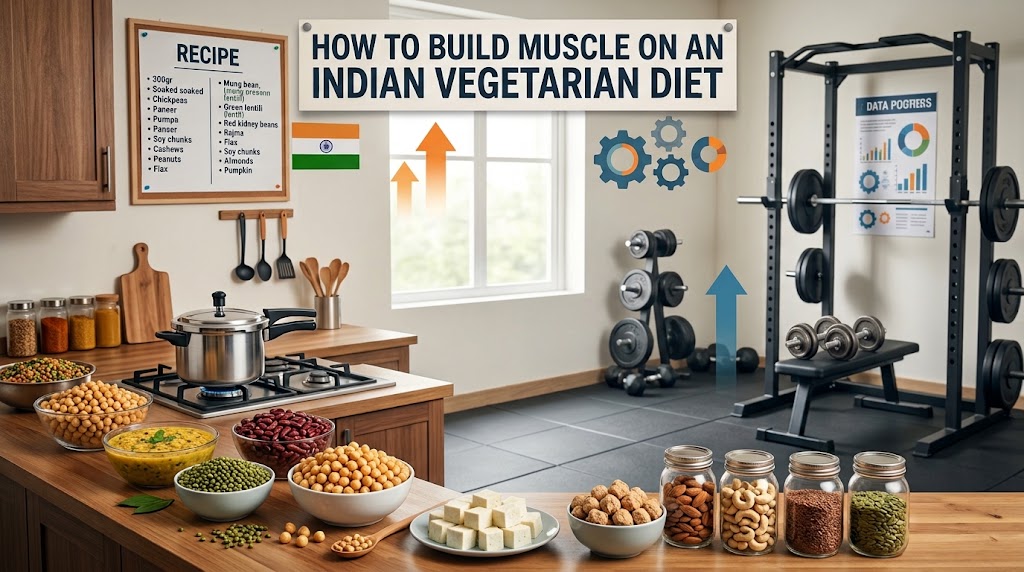
"Vegetarians can't build real muscle" is one of the most repeated lies in Indian gyms. It survives because most vegetarian lifters undereat protein, skip progressive overload, and blame their diet for a training problem. Paneer, dal, curd, and soya can absolutely build a muscular physique — the plan just needs to be built correctly. Some of the most muscular athletes in the country, including several competitive Indian bodybuilders, have trained on a fully vegetarian diet their entire lives.
Why Most Vegetarian Bulking Attempts Fail
Two mistakes repeat across almost every stalled vegetarian lifter: not enough total protein, and not enough total calories. Dal and roti alone don't come close to a muscle-building protein target, and "eating clean" often quietly turns into eating too little to grow.
Muscle needs a calorie surplus and a protein target, not just clean eating. Without both, even perfect training sessions in the gym produce almost nothing to show for them.
There's also a myth about protein "completeness" that stops a lot of vegetarians from eating enough. Yes, individual plant proteins are missing one or two amino acids that animal protein has — but eating dal with rice, or roti with rajma, across the same day gives you every amino acid you need. You don't have to combine them in the same bite or even the same meal; your body pools amino acids across the day.
The Vegetarian Protein Stack
You don't need imported protein powders to hit a real number — you need a stack of dense vegetarian sources eaten at every meal, not once a day.
The reason this trips people up is that vegetarian proteins tend to be lower density per gram than meat or eggs — you need a larger volume of dal or rajma to hit the same protein number as a smaller portion of chicken or fish. That's not a disadvantage, it just means portions need to be genuinely generous rather than the small "side dish" quantity dal is traditionally served in.
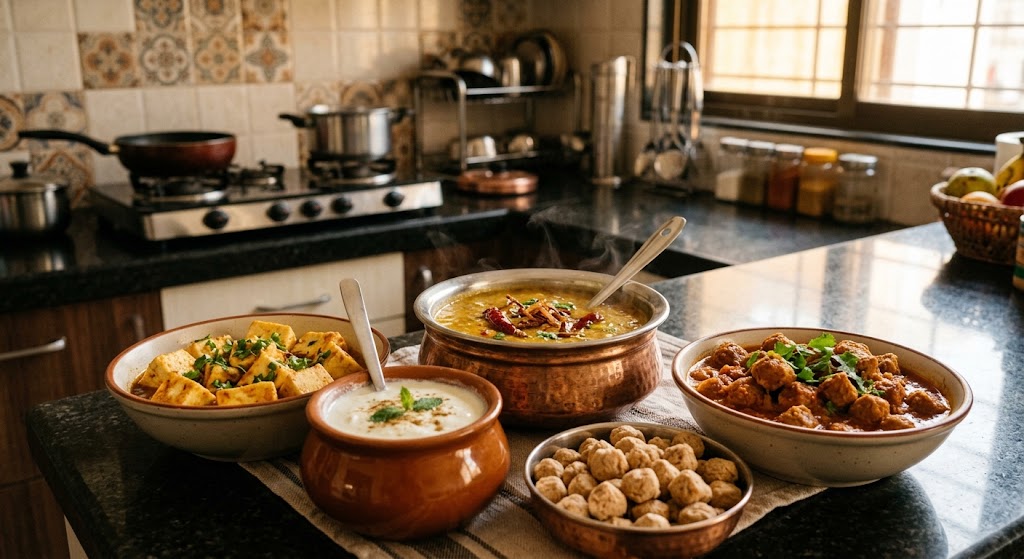
- Paneer — roughly 18-20g protein per 100g, cooked into sabzi, bhurji, or grilled
- Soya chunks — very high protein per gram and cheap; soak, boil, and add to curries
- Curd and Greek-style hung curd — easy to add to every meal without extra cooking
- Whole moong, chana, rajma, and mixed dal — combine with rice or roti for a complete amino acid profile
- Sprouts — nearly zero prep, high protein-to-calorie ratio
- Whey or plant protein shake — only needed to close the gap if whole food alone falls short
Building the Surplus
- Calculate maintenance calories, then add roughly 250-350 calories a day for a lean bulk.
- Set a protein target around 1.6-1.8g per kg of bodyweight and hit it daily, not on average.
- Add a second protein-dense meal instead of one giant dinner — easier on digestion, easier to hit the target.
- Use ghee, nuts, and peanut butter to add calories without adding excessive volume of food.
- Track for 2 weeks, then adjust — most vegetarian lifters are eating 300-500 calories short of what they think.
A working day looks like: paneer bhurji with 2 rotis for breakfast, rajma-chawal with curd for lunch, roasted soya chunks or sprouts as a snack, and a dal-heavy dinner with a glass of milk before bed. Four protein touchpoints, not one.
Do You Need Supplements at All?
A whey or plant protein shake is useful purely as a convenience — a fast way to close a 20-30g gap on a busy day without cooking another dish. It is not magic and it is not required; a diet that hits the daily protein number through whole food alone builds muscle exactly as well as one that uses a shake to get there.
Creatine monohydrate is the one supplement with genuinely strong evidence behind it for strength and muscle gain, and it's vegetarian-friendly and inexpensive. Multivitamins, mass gainers, and "muscle building" powders sold with bold claims are mostly unnecessary if the core diet — calories, protein, and whole foods — is already in place.
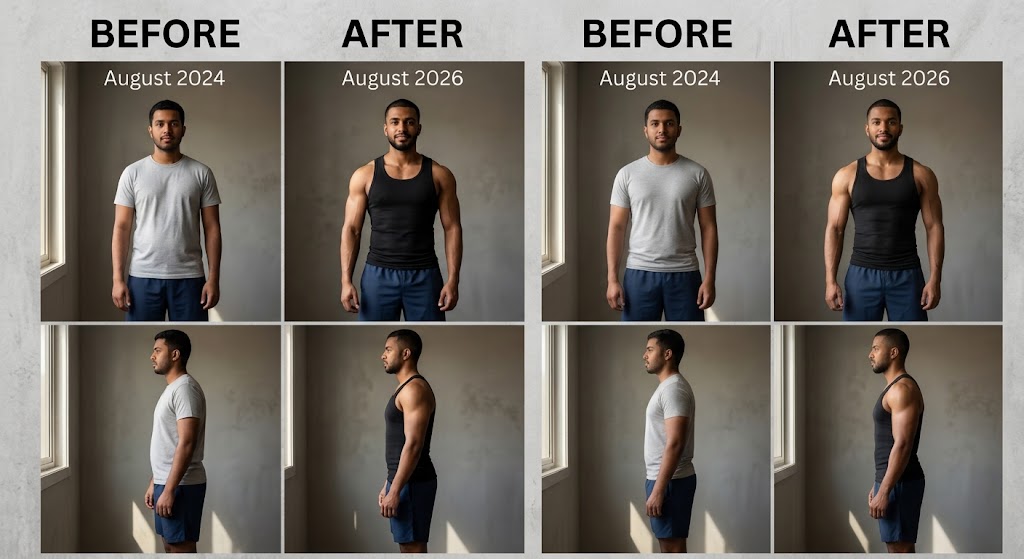
Case Study: Arjun, 24, Bangalore
Arjun trained five days a week for over a year with almost nothing to show for it. His workouts looked fine on paper — the problem was his food. He was eating below maintenance most days, chasing a lean look without the calories to actually grow.
Once he tracked for two weeks, the gap was obvious — he was short on both calories and protein by a wide margin. Adding two structured protein-dense meals and a modest surplus changed his trajectory within 8-10 weeks, with visible shoulder and arm size he hadn't gained in the previous year of training.
He also stopped switching his workout every time he saw a new routine online. Sticking to the same four-day split for eight straight weeks, and simply trying to beat his previous numbers each session, did more for his physique than the entire previous year of "trying everything."
Vegetarian muscle isn't slower muscle. It's just muscle that needs the numbers tracked more carefully.
Training for Growth, Not Just Sweat
- Follow a structured push-pull-legs or upper-lower split, not random daily workouts
- Progressively add weight or reps every 1-2 weeks — this is the actual growth trigger
- Prioritise compound lifts — squat, deadlift, bench or push-ups, rows — before isolation work
- Rest 48 hours minimum before training the same muscle group again
- Sleep 7+ hours — this is where the actual repair and growth happens
A simple beginner-friendly split looks like: upper body push and pull movements on day one, lower body squats and hinges on day two, a rest or light-activity day, then a repeat of the same two sessions. Four training days a week is enough to drive consistent growth without needing to live at the gym, as long as each session is progressively getting harder over time rather than staying identical week after week.
Meal Timing Around Training
Eating a protein-and-carb combination within roughly two hours of a workout — whether before or after — supports recovery better than leaving a long gap. A simple pre-workout option is a banana with roasted chana or a glass of milk; post-workout, a paneer or soya-based meal with rice or roti covers both recovery needs at once. This doesn't have to be precisely timed to the minute — the old idea of a tiny "anabolic window" you must hit within 30 minutes has been overstated; what matters is the whole day's total protein and getting a real meal in reasonably close to training.
Common Mistakes
- Relying on dal-roti alone for protein. Fix: add paneer, soya, or curd to every single meal.
- Fearing all fat and staying too lean to grow. Fix: allow a small, controlled calorie surplus.
- Changing workout routines every week. Fix: follow one structured split for at least 8-12 weeks.
- Skipping protein at breakfast. Fix: start the day with paneer, curd, or a protein shake, not just tea and biscuits.
- Not tracking anything. Fix: log food for at least 2 weeks to see the real gap.
How to Know It's Working
- Bodyweight trending up 0.25-0.5 kg per week on average
- Key lifts adding weight or reps most weeks
- Waist staying roughly stable, not climbing fast — a sign the surplus isn't too aggressive
- Energy in the gym improving session to session
If bodyweight is climbing faster than the range above, the surplus is likely too large and can be trimmed slightly without slowing down muscle gain — the goal is steady growth, not the fastest possible weight gain on the scale.
FAQ
Is soya bad for hormones if eaten daily?
For most people, moderate daily soya intake (a bowl of chunks or a glass of soy milk) is not a hormonal concern — the research on this is far more reassuring than gym folklore suggests.
Do I need a protein powder to build muscle as a vegetarian?
No — it's a convenience tool, not a requirement. Whole food can hit the target; a shake just makes hitting it easier on busy days.
How long until I see visible muscle growth?
With consistent training, adequate protein, and a real surplus, most beginners notice visible changes within 8-12 weeks, with meaningful size by 6 months.
Will I gain too much fat while bulking vegetarian?
Only if the surplus is too large. A modest surplus of 250-350 calories, combined with consistent strength training, keeps fat gain minimal while still fuelling muscle growth — you don't need to eat everything in sight to grow.
Your 30-Day Plan
- Week 1: track food as-is, no changes, to find your real baseline.
- Week 2: add one protein source to every meal and a small calorie surplus.
- Week 3: lock in a structured 4-day training split with progressive overload.
- Week 4: re-check bodyweight trend and lift numbers, adjust calories if either is flat.
Vegetarian muscle-building isn't a compromise plan — it's a precision plan. If you want the meals and the split built around your actual numbers with a coach checking in on WhatsApp, our 12-week program does exactly that instead of handing you a generic template.