Intermittent Fasting: Does It Actually Work for Weight Loss?
Fasting windows don't burn fat by themselves. Here's the honest mechanism behind intermittent fasting, and how to know if it fits your life.
Intermittent fasting is one of the most searched weight loss methods in the world, and also one of the most oversold. It isn't a special metabolic trick that melts fat while you sleep. It's a way of structuring when you eat, and for a lot of people, that structure makes it easier to eat less overall — which is the actual reason it produces weight loss when it does.
What intermittent fasting actually is
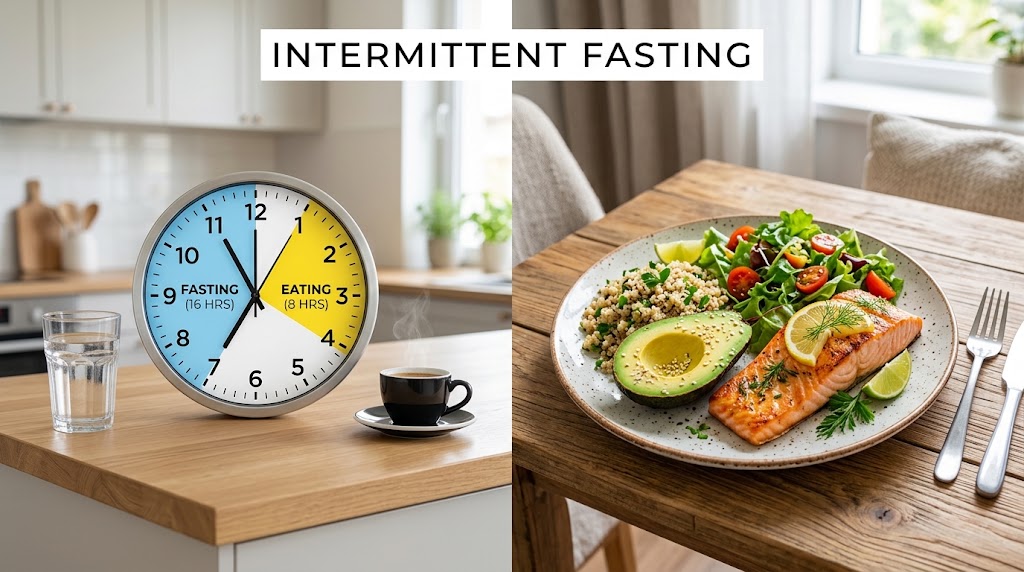
At its core, intermittent fasting means restricting your eating to a specific window of time each day, or eating normally on some days and much less on others. The most common version, often called 16:8, involves an 8-hour eating window and a 16-hour fast, usually achieved by skipping breakfast or eating an early dinner. Other versions exist — alternate-day fasting, or eating normally five days a week and much less on two — but the mechanism behind all of them is the same.
Intermittent fasting works for weight loss when it leads to eating fewer total calories, not because fasting itself burns extra fat. Compress your eating into a shorter window, and you naturally have less time to eat, which for many people means eating less overall without consciously restricting each meal. That's the actual lever. If someone eats the same total calories inside a shorter window, they will not lose additional weight compared to spreading those same calories across the full day.
Who tends to benefit from it
Some people find that a fasting window genuinely reduces their overall hunger and food noise through the day, because they're not managing three or four separate eating decisions — just one or two. People who tend to overeat at breakfast, or who find themselves snacking mindlessly through a long day, sometimes do better with a defined window that removes the decision entirely.
It can also simplify meal planning. Two solid meals a day is often easier to plan, cook, and track than five smaller ones, particularly for people with unpredictable schedules or limited time to cook.
Who tends to struggle with it
People who train early in the morning often find a long fasting window works against their energy and performance in the gym, especially for strength training. Anyone prone to blood sugar crashes, or with a history of disordered eating, should be cautious — a rigid eating window can trigger overeating once it opens, undoing the calorie benefit entirely. Fasting isn't recommended during pregnancy or while breastfeeding, and anyone managing diabetes or another condition affected by meal timing should only try it under medical guidance.
- Trains fasted comfortably, without feeling drained mid-workout
- Doesn't feel compelled to overeat once the eating window opens
- Has no medical condition where meal timing matters (diabetes, pregnancy, a history of disordered eating)
- Finds the structure calming rather than stressful
If most of that doesn't describe you, a normal eating pattern with a calorie deficit will work just as well, without the added friction.
Intermittent fasting is a tool for eating less without feeling restricted — not a separate weight loss method with its own rules.
What the research actually shows
Multiple studies comparing intermittent fasting to standard calorie-restricted diets, matched for total calories, have found roughly similar weight loss between the two approaches. This is consistent with the underlying mechanism — total calorie intake predicts weight change far more strongly than the timing of when those calories are eaten. Where fasting sometimes shows a modest edge is adherence: some people find it easier to stick to consistently than a more traditional structure of several smaller meals, simply because there's less to plan and decide.
Popular fasting styles compared
The 16:8 method is the most common entry point because it's the easiest to fit around a normal day — skip breakfast, eat lunch and dinner within an 8-hour window. A stricter 18:6 or 20:4 window compresses eating further and tends to suit people who naturally aren't hungry until midday, but it leaves less room for social meals and can be harder to sustain during travel or family events. Alternate-day fasting, eating normally one day and much less the next, produces a similar average calorie reduction over a week but asks for more willpower on the low-calorie days specifically. None of these is inherently superior — the version that fits your actual week without constant negotiation is the one worth trying.
How to start without it backfiring
Jumping straight into a strict 16-hour fast in week one is a common reason people abandon the approach within days. A gentler entry — pushing breakfast back by an hour or two every few days until you reach your target window — gives your hunger cues time to adjust gradually rather than fighting a sudden, large shift. Staying hydrated during the fasting hours, and making sure the first meal after the fast isn't oversized to "make up for lost time," both make the adjustment period considerably smoother.
Common mistakes
- Assuming the fasting window itself burns fat — fix: understand it only works through eating less overall
- Overeating heavily once the window opens, cancelling out the deficit — fix: still plan meals with portion awareness inside the window
- Fasting while training hard without adjusting — fix: schedule your hardest sessions closer to your eating window if performance drops
- Choosing a fasting schedule that clashes with family meals or work life — fix: pick a window your actual daily schedule supports long-term
- Treating it as mandatory for weight loss — fix: it's one option among several, not a requirement
- Ignoring hunger signals that are genuinely disruptive rather than pushing through — fix: adjust the window or abandon the approach if it consistently causes distress
How to know it's working
- Total daily calorie intake trending toward your target, even without formal tracking
- Hunger through the day feeling manageable rather than constant
- Energy staying reasonably stable during your eating window and through workouts
- Weekly average weight trending in the expected direction
- The eating pattern feeling sustainable rather than like a countdown you're enduring
Fasting and women's hormones
Some evidence and a fair amount of anecdotal reporting suggests women can be more sensitive to aggressive fasting schedules than men, occasionally experiencing disrupted cycles or increased stress symptoms on very restrictive windows like 20:4 or extended multi-day fasts. This doesn't mean fasting is off-limits — a moderate window like 14:10 or 16:8 is generally well tolerated — but it's a reason to start conservatively and pay attention to how your body actually responds over the first few weeks, rather than assuming a stricter window is automatically more effective.
FAQ
Does intermittent fasting boost metabolism? Not meaningfully. Short-term fasting has a small, temporary effect on certain hormones, but it doesn't create a lasting metabolic advantage over eating the same calories on a normal schedule.
Can I drink coffee or tea during the fasting window? Yes, as long as it's black or without added calories. Milk, sugar, or cream in your coffee technically breaks a fast in the strict sense, though a small amount is unlikely to meaningfully change your results if your overall calories are on target.
Is intermittent fasting safe for building muscle? It's possible to build muscle while following an intermittent fasting schedule, as long as total daily protein and calories support it. The eating window doesn't need to change that math — it just changes how those calories are distributed across the day.
Will I lose muscle from fasting? Not specifically from the fasting window itself, as long as total protein intake and resistance training stay adequate across the days you're eating. Muscle loss during any diet comes primarily from inadequate protein and inactivity, not from meal timing.
What breaking a fast the wrong way looks like
The eating window can quietly undo the whole benefit if the first meal after a long fast is treated as a reward rather than a normal meal. A large, calorie-dense meal eaten quickly after 16+ hours without food is easy to overdo, since hunger and appetite regulation can feel less precise right after a long fast than during a normal eating rhythm. Starting the window with a moderate, protein-forward meal rather than the largest meal of the day tends to keep the rest of the window easier to manage and closer to the intended calorie target.
Putting it together
- Decide if a shorter eating window genuinely reduces your hunger and effort, or just adds stress
- Pick a window that fits your actual schedule, not an ideal one you'll abandon in two weeks
- Keep total calories and protein on target inside that window
- Adjust training timing if fasted workouts feel noticeably weaker
- Judge results the same way as any other approach — weekly weight trend and measurements
Intermittent fasting is a legitimate tool for some people and an unnecessary complication for others. Both are fine outcomes — what matters is whether it makes your calorie deficit easier or harder to sustain. If you want a meal structure built around what actually fits your schedule, fasting window or not, check our 12-week program.