Why Am I Not Losing Weight Even Though I'm Eating Less? 9 Real Reasons
You cut your food, you skipped the sweets, and the scale has not moved in weeks. Here are the nine reasons weight loss stalls — and the fix for each one, ranked by how common they actually are.
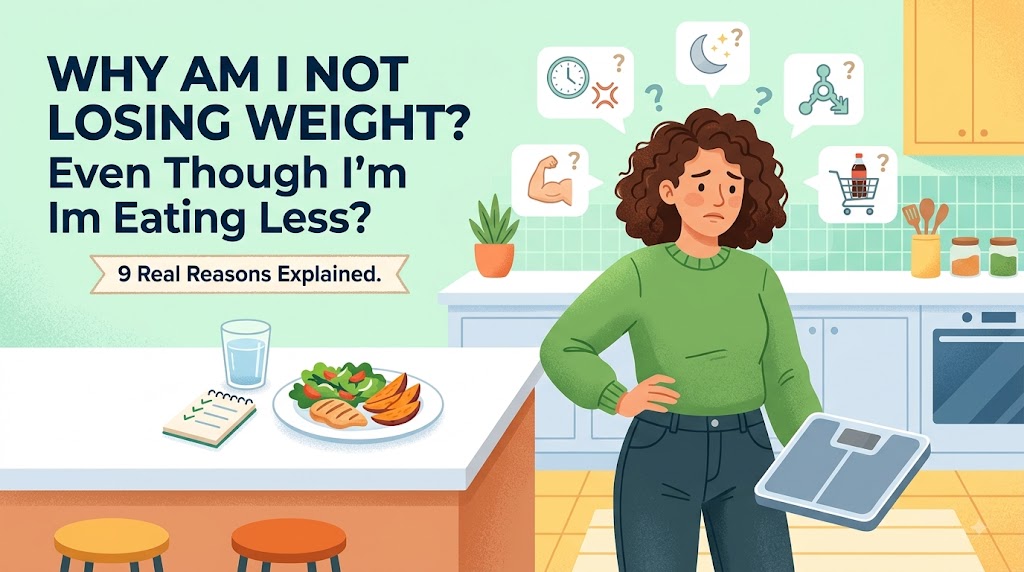
You have been eating less for three weeks. You gave up sugar in your chai. You stopped the evening samosa. And the scale is sitting exactly where it started.
This is the most common and most demoralising moment in any fat-loss attempt — and it almost never means your body is broken. In nearly every case it comes down to one of nine things.
They are listed here in order of how often they turn out to be the culprit.
1. You Are Eating More Than You Think (By a Lot)
This is the answer 7 times out of 10, and it is not about lying to yourself. It is about the calories that never register as 'food'.
- Cooking oil — one tablespoon is 120 kcal. Most Indian households use 3–4 tablespoons per dish without measuring.
- Tasting while cooking — five small tastes can be 150 kcal.
- Chai with sugar — 4 cups a day at 2 tsp sugar each is roughly 250 kcal.
- 'Healthy' extras — ghee on roti, dry fruits by the handful, fruit juice, granola.
- Weekends — two restaurant meals can wipe out an entire week's deficit.
2. You Are Losing Fat, But Water Is Hiding It
Body fat does not vanish neatly. When a fat cell empties, it often holds water for days or weeks before it releases — so the scale stays flat while you are genuinely getting leaner.
Add to that: salty food, high stress, poor sleep, a hard workout, and the menstrual cycle can each swing the scale by 1–2 kg with zero change in fat.
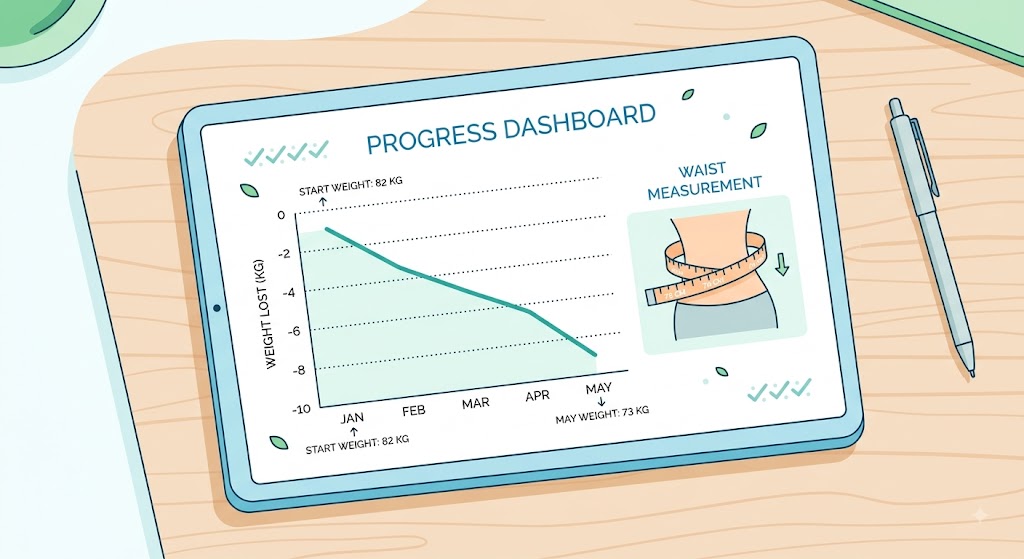
- The fix: stop reading single weigh-ins. Weigh daily under the same conditions and compare this week's average to last week's average. Also measure your waist once a week — it often moves when the scale does not.
3. You Are Building Muscle While Losing Fat
If you recently started strength training — especially as a beginner or after a long break — you can gain muscle and lose fat at the same time. The scale barely moves. Your body changes completely.
Signs this is what is happening: clothes are looser, the mirror looks different, your lifts are going up, but the number is stuck. That is a win, not a stall.
4. Your Deficit Is Smaller Than You Assumed
Online calorie calculators give estimates, and estimates can be off by 200–300 calories in either direction. If your real maintenance is 1,900 and you assumed 2,200, then 'eating less' at 1,900 is actually eating exactly at maintenance.
There is a second version of this: as you lose weight, your maintenance drops. The intake that created a deficit at 85 kg may be maintenance at 78 kg.
- The fix: recalculate with the BMR & TDEE Calculator at your current weight, then subtract 500. Repeat every time you lose 4–5 kg.
5. You Are Moving Less Without Realising It
When you eat less, your body quietly turns down non-exercise movement — you fidget less, walk slower, take the lift, sit more. This can cost 200–400 calories a day and it happens entirely below conscious awareness.
- The fix: put a step target on your phone and defend it. 8,000–10,000 steps a day keeps this from eating your deficit.
6. You Are Not Eating Enough Protein
Low protein does not stop fat loss directly. It does two other things: it makes you hungry enough to break the diet, and it means part of the weight you lose is muscle — which lowers your metabolism and makes the next kilo harder.
- The fix: get to 1.4–1.6 g per kg of body weight. Anchor every meal with eggs, dal, curd, paneer, sprouts, soya, or chicken. Full breakdown in the protein guide.
7. You Are Sleeping Badly
Short sleep raises ghrelin (hunger) and lowers leptin (fullness). Five-hour nights make a 1,600-calorie day feel unbearable, and they push you toward exactly the high-sugar, high-fat foods that end the diet.
- The fix: 7–8 hours, consistent timings, phone out of the bed. This is not soft advice — it is one of the highest-return changes available.
8. Chronic Stress Is Working Against You
Sustained high stress raises cortisol, which increases water retention (a masking effect on the scale) and drives appetite. Work pressure, exams, family stress, and over-training all count.
- The fix: you cannot delete stress, but you can stop stacking it. Do not run a hard deficit and daily HIIT and five hours of sleep during your most stressful month. Pick a moderate deficit and hold it.
9. There Is an Underlying Medical Reason
This is last on the list because it is the least common — but it is real. An underactive thyroid, PCOS, insulin resistance, or certain medications can genuinely slow fat loss.
How Long Should a Stall Last Before You Change Something?
Two to three weeks of a flat 7-day average, with accurate tracking, is a real stall. Anything shorter is noise.
When it is real, change one thing at a time, in this order:
- Tighten tracking for 7 days (oil, weekends, tastes)
- Add 1,500 steps a day
- Only then reduce calories by 150–200
Cutting calories should always be the last lever, not the first.
FAQ
Can eating too little stop weight loss completely?
Not in the way the phrase 'starvation mode' suggests — your metabolism does not shut down. What does happen is that very low intake reduces daily movement, costs you muscle, and drives binges that erase the deficit. The net effect looks like a stall, but the cause is behavioural, not metabolic.
How long does a weight loss plateau usually last?
Genuine plateaus typically last 2–4 weeks. If tracking is accurate and nothing has moved after 3 weeks, that is when to adjust steps or calories.
Why does my weight go up after a workout?
Hard training causes temporary muscle inflammation and water retention, and it can add 0.5–1.5 kg on the scale for a few days. It is water, not fat, and it clears on its own.
Should I do more cardio if the scale is stuck?
Add walking before you add hard cardio. Walking increases your burn without spiking appetite or recovery cost, so the deficit actually survives. Intense cardio often gets fully compensated by extra eating and extra rest later in the day.
Is it possible to lose fat but gain weight?
Yes — new lifters, people returning after a break, and anyone increasing protein and training volume can gain muscle and water while losing fat. Waist measurement and photos will show the truth better than the scale does.
Where to Go From Here
Tired of guessing? Tracqfit tracks your intake, weight trend, and weekly average in one place so you can see whether you are actually stalled — or just looking at a noisy number.