How to Lose 10 Kg in 3 Months: A Realistic Indian Plan That Works
Losing 10 kg in 3 months is possible for most people — but only with the right calorie deficit, enough protein, and a plan built around Indian food. Here is the exact week-by-week approach.
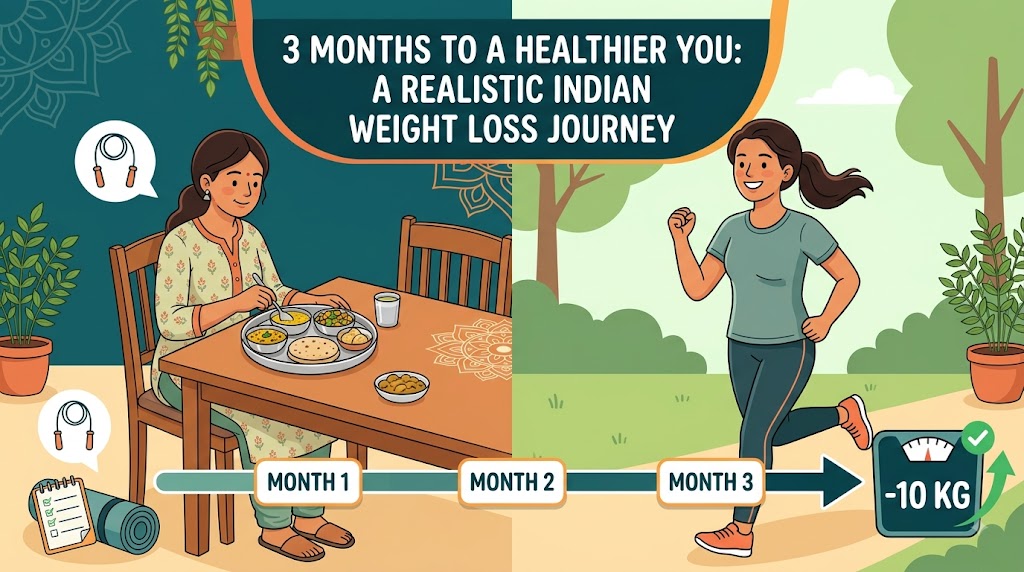
Ten kilos in three months. It is one of the most searched fitness goals in India, and it is also where most people quietly give up by week three.
Here is the honest answer: for most people carrying extra weight, 10 kg in 3 months is achievable and safe. It works out to roughly 0.8 kg a week. That is on the aggressive side of sensible, but it is nowhere near the crash-diet territory where you lose muscle, hair, and your sanity.
What decides whether you get there is not willpower. It is arithmetic, protein, and a plan you can repeat on a Tuesday when you are tired.
The Maths: What 10 Kg Actually Costs You
One kilo of body fat holds roughly 7,700 calories. Ten kilos is about 77,000 calories you need to not eat over 90 days.
Divide it out and you need an average daily deficit of around 850 calories. That sounds brutal until you split it in two:
- 500–600 calories from food — smaller portions of rice/roti, less oil, no sugary drinks, no daily snacking
- 250–350 calories from movement — a 45-minute walk plus 3–4 strength sessions a week
Nobody hits 850 every single day. Some days you will be at 1,000, some days at zero because it is a wedding. The average over 90 days is what counts, which is exactly why single bad days do not matter and bad weeks do.
Step 1: Set Your Calorie Target (Not Someone Else's)
Take your TDEE — the calories you burn in a normal day — and subtract 500 to 600. That is your daily eating target.
Two guardrails that matter more than the exact number:
- Never eat below 1,200 kcal (women) or 1,500 kcal (men). Below that you lose muscle fast, your energy tanks, and the weight comes back the moment you eat normally.
- If your deficit hits that floor, make up the difference with movement, not more restriction. A 10,000-step day is worth 300–400 calories for most adults.
A 90 kg man with a desk job typically lands around 2,600 TDEE, so he eats ~2,050. A 75 kg woman with a desk job lands around 1,900, so she eats ~1,400. Those are starting points, not commandments — you adjust in week three based on the scale, which we will get to.
Step 2: Protein First, Everything Else Second
This is the single biggest difference between losing 10 kg of fat and losing 7 kg of fat plus 3 kg of muscle. The scale reads the same. Your body does not.
Aim for 1.4 to 1.6 grams of protein per kilo of your current body weight. For an 80 kg person that is 112–128 g a day. It is more than most Indian diets deliver by default, and it is the fix for constant hunger.
- 2 eggs — 12 g
- 100 g paneer — 18 g
- 1 cup cooked dal — 9 g
- 1 cup curd — 8 g
- 1 katori sprouts — 10 g
- 100 g chicken breast — 27 g
- 1 scoop whey — 24 g
Build every meal around one of these and the rest of the diet more or less handles itself. More detail here: How Much Protein Do You Actually Need Daily?

Step 3: A Day of Eating That Does Not Feel Like a Diet
This is a ~1,600 kcal template. Scale portions up or down to hit your own target — the structure stays identical.
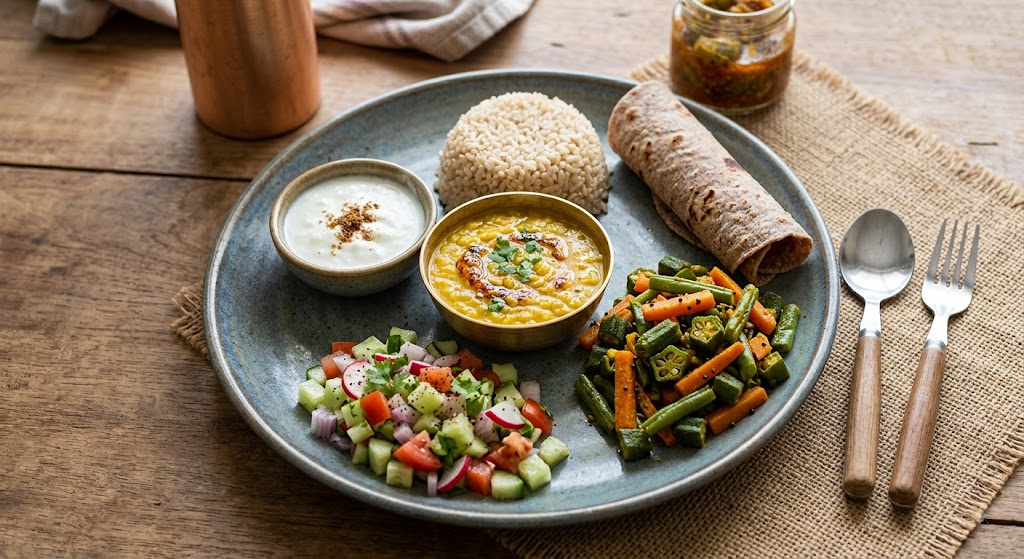
- Breakfast — 3-egg masala omelette + 1 multigrain toast, or 2 moong dal chilla with a bowl of curd
- Lunch — 2 roti + 1 katori dal + 1 katori sabzi + salad + curd (rice is fine, just measure it)
- Evening — chai without sugar + roasted chana or a handful of peanuts, or a boiled egg
- Dinner — grilled chicken / paneer / rajma with a large plate of vegetables, light on the carbs
Notice what is not here: no imported superfoods, no separate cooking, no giving up roti. If you want the full version, read the Indian Diet Plan for Fat Loss.
Step 4: Training — 4 Sessions, 45 Minutes Each
Cardio burns calories while you do it. Strength training protects the muscle that keeps your metabolism up for the whole 90 days. You want both, in that priority order.
- 3–4 strength sessions a week — full body or an upper/lower split. Squats, push-ups, rows, presses, deadlifts or their machine equivalents.
- 7,000–10,000 steps daily — the most underrated fat-loss tool in existence, and it does not make you hungry the way hard cardio does.
- Optional: 2 short cardio finishers — 10–15 minutes of incline walking or cycling after lifting.
No gym? The home workout plan for beginners covers the same bases with zero equipment.
The Week-by-Week Reality Check
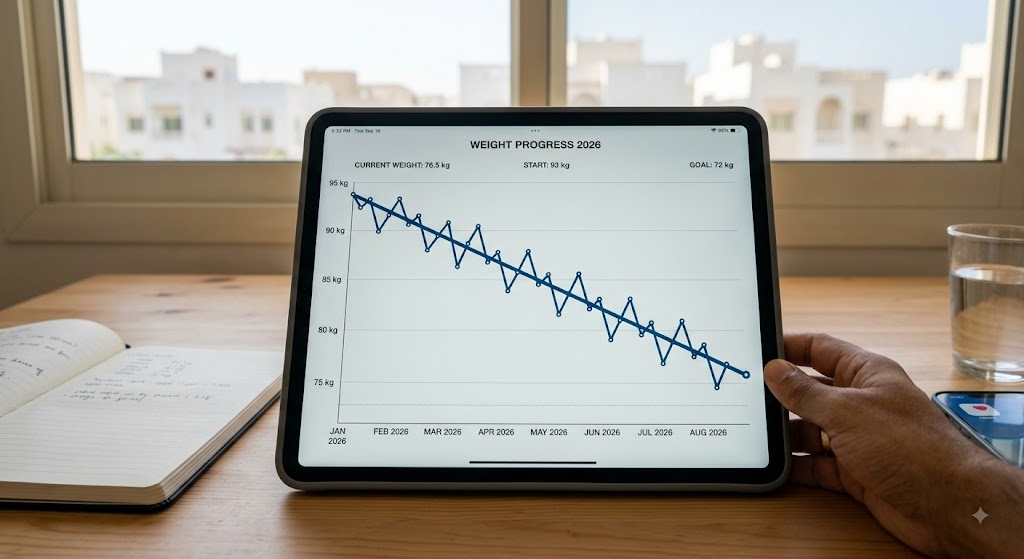
Progress will not be linear, and knowing the shape of it in advance stops you from quitting.
- Weeks 1–2 — fast. You may drop 2–3 kg. Most of it is water and glycogen. Enjoy it, do not get attached to the rate.
- Weeks 3–5 — steady. 0.7–1 kg a week. This is real fat loss. This is also where boredom kicks in.
- Weeks 6–8 — the stall. The scale may not move for 10 days while your waist keeps shrinking. Do not cut calories again yet. Check sleep, salt, and stress first.
- Weeks 9–12 — the grind. You are lighter, so your TDEE is lower. Recalculate your target and add 1,000 steps a day.
Why Most People Fail at This (And How Not To)
- They go too hard, too early. A 1,200 kcal crash diet in week one guarantees a binge in week three.
- They eat too little protein. Then they are hungry all day and blame their discipline.
- They only track weekdays. Two unmeasured weekend days can erase a full week's deficit.
- They quit at the first stall. The stall is a normal part of the process, not a sign the plan failed.
- They sleep 5 hours. Poor sleep raises hunger hormones and makes every other step harder.
If you are already doing everything right and the scale still will not move, read Why Am I Not Losing Weight Even Though I'm Eating Less? — it covers the nine real reasons.
Is 10 Kg the Right Goal for You?
If you are 20 kg over a healthy weight, 10 kg in 3 months is a great first chapter. If you are already close to a healthy weight, 10 kg may be too much and too fast — you would be better off targeting 4–5 kg and focusing on strength.
Check where you actually stand with the Ideal Weight Calculator before committing to a number.
FAQ
Can I really lose 10 kg in 3 months without any supplements?
Yes. Supplements do not cause fat loss — a calorie deficit does. Whey protein is a convenience, not a requirement. If you can hit your protein target with eggs, dal, curd, paneer, and chicken, you need nothing else.
How much weight will I lose in the first week?
Usually 1.5–3 kg, and most of it is water rather than fat. This is normal and it does not continue at that rate. Expect it to settle to 0.7–1 kg a week from week three onward.
Do I have to give up rice and roti to lose 10 kg?
No. Total calories decide fat loss, not any single food. Most people succeed by reducing their rice/roti portion by about a third and filling the gap with vegetables and protein, rather than cutting carbs out entirely.
What should I do if my weight stops moving for two weeks?
First check the basics: are you still measuring oil, are weekends being tracked, are you sleeping enough. If all of that is solid, add 1,500 steps a day for a week before cutting any calories. Recalculate your TDEE — after losing 5 kg, your maintenance calories are genuinely lower.
Is losing 10 kg in 3 months safe?
For most people with excess weight, yes — it works out to roughly 0.8 kg a week, which is within the widely used safe range of 0.5–1% of body weight per week. It is not appropriate if you are pregnant, underweight, recovering from illness, or managing a medical condition without supervision. Check with your doctor if any of those apply.
Where to Go From Here
Want the plan built around your numbers instead of a template? Tracqfit gives you a calorie and protein target from your own body data, tracks your daily progress, and adjusts as you lose weight.